
Affiliate Disclosure: EntrywayConsoleTable is reader-supported. When you buy through links on this site, we may earn a small commission at no extra cost to you.
Entryway lighting does more than help you find keys — it sets mood, flatters faces, and makes a small foyer feel twice as large. Yet most consoles rely on a harsh overhead alone, leaving the tabletop in shadow and the welcome feeling cold.
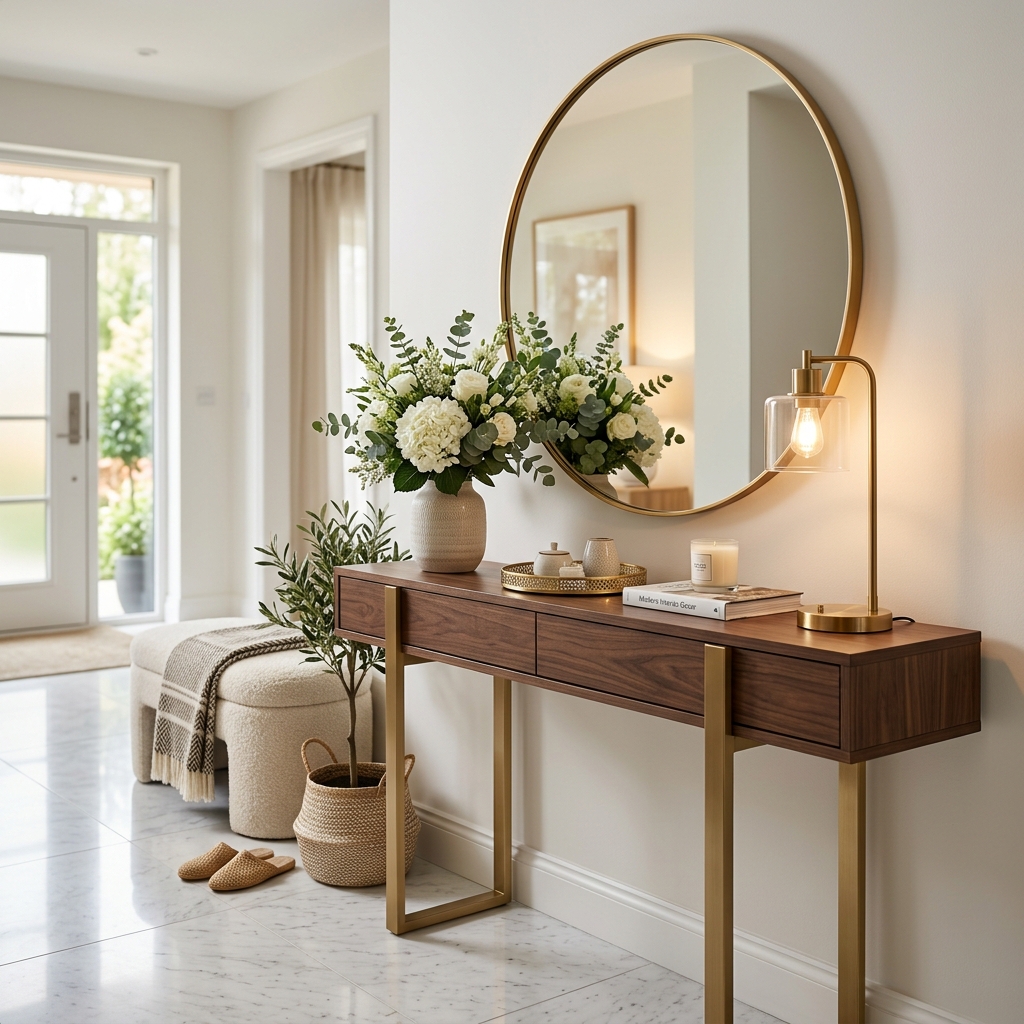
Layered console lighting fixes that in minutes. A warm lamp pool, a mirror bounce, and a flicker of candlelight turn even a windowless hall into an inviting glow.
Quick answer: Light consoles with a 24-28 inch lamp (2700K-3000K, 400-800 lumens) on one side, sconces or candles for layering, and a mirror behind to double brightness. Keep shade bottoms at 58-64 inches and hide cords down the back leg.
Key Takeaways
- Lamp scale: 24-28 in tall, shade 10-14 in diameter, never wider than table depth
- Bulbs: 2700K-3000K warm white, 400-600 lumens ambient, 800 lumens for task zones
- Layer three levels: ambient lamp + accent candles/fairy lights + mirror bounce
- Sconces mount 60-66 in center height, 12-18 in above table surface
- Hide cords with clips, covers, baskets, or go cordless with rechargeable LEDs
Table Lamps: Size, Shade, and Placement
Choosing the Right Lamp Scale
Match lamp to console length and depth. On a 48-inch console, one 26-inch lamp leaves room for vase + tray. On 60-72 inch consoles, try two 24-inch matching lamps for symmetry. Depth rule: shade diameter must be 1-2 inches narrower than table depth — 10-inch shades for 12-inch tables, 12-14 inch shades for 14-16 inch tables.
Base materials matter: ceramic and stone add weight and stability on high-traffic tables; brass and glass add reflectivity in dark halls. Keep base footprint under 8x8 inches so 20-30% surface stays clear.
Height check: with a 31-inch console + 26-inch lamp, shade bottom lands around 52 inches — add 6-10 inch riser books if needed to reach glare-free 58-inch eye level in tall foyers.
Shades and Bulbs That Flatter
Linen drum shades diffuse warmly and suit modern organic, farmhouse, and transitional entries. Tapered empire shades read traditional; opaque metal shades create dramatic down-pools for art. White shades maximize brightness, natural linen warms light by ~200K.
Choose LEDs with CRI 90+ so wood tones and art colors stay true. Dimmable is non-negotiable — full 800 lumens for cleaning and mail sorting, 300 lumens dimmed for evening welcome. Smart bulbs with schedules auto-greet you at sunset.
Avoid bare Edison bulbs at eye level in entries — they glare in mirrors and age faces unflatteringly.
Beyond the Lamp: Sconces, Candles, and Smart Light
Sconces and Wall Washers
Sconces free the surface entirely — ideal for 10-inch deep consoles in tight halls. Hardwired pairs flanking a 32-inch mirror create hotel polish; plug-in picture lights above art add gallery drama without electricians.
Mounting math: bottom of shade 12-18 inches above tabletop, fixture center 60-66 inches from floor. Space pairs 28-36 inches apart centered on mirror. Choose 3000K integrated LEDs or 2700K candelabra bulbs at 300-450 lumens each to avoid hotspots.
Renter hack: battery sconces with remote dimming mount with adhesive strips and run 30-60 hours per charge — perfect above consoles with no outlet.
Candles, Fairy Lights, and Dimmers
Top your lamp layer with flicker: two flameless LED pillars 4 and 6 inches high in glass hurricanes add depth without fire risk. Tuck battery fairy lights in a glass vase or under a tray edge for 2700K sparkle during holidays.
| Lighting Type | Best Lumens | Color Temp | When to Use |
|---|---|---|---|
| Table lamp ambient | 400-600 | 2700K-3000K | Daily welcome glow |
| Task / mail sorting | 750-800 dimmable | 3000K | Reading labels, writing |
| Sconce accent | 300-450 each | 2700K-3000K | Surface-free halls |
| Candle / fairy accent | 20-80 | 2200K-2700K | Evening mood, holidays |
Dimmers on every source let one console shift from bright morning to moody evening. Plug lamps into a smart plug grouped with sconces for one-tap scenes.
Learn surface layering in the console table vignette guide, anchor light with mirror and art pairing, and browse full looks in console table decor ideas.
Styling Light With Decor
Reflect and Diffuse
Place lamps 8-10 inches in front of mirrors to double output without blinding. Pair dark wood consoles with translucent shades that throw light sideways; pair white consoles with warmer 2700K bulbs to avoid sterile washout.
Metallic trays, mercury glass, and polished frames amplify lamp glow — scatter one or two, not five, to avoid disco effect. Matte ceramics absorb light and calm overly bright corners.
Under-table glow: LED strip tucked under a 31-inch console apron at 2700K washes baskets and floors, making narrow halls feel wider after dark.
Cords, Safety, and Small Halls
Safety first: keep shade 6 inches from art frames and 12 inches from dried stems. LED bulbs stay cool; halogen does not — never use halogen near faux botanicals. Anchor consoles over 30 inches tall if kids pull cords.
Cord plan: measure outlet to lamp, buy 6-ft flat plug extension in wall color, clip vertically down back leg, hide slack in a lidded basket below. For glass consoles where backs show, route through a hollow book or behind stacked boxes.
Small-hall formula: 10-inch deep console + plug-in sconces + round 24-inch mirror + one 12-inch tray = full light and function in 36-inch walkway without a single tabletop lamp.
Common Mistakes to Avoid
Shade wider than table. Overhanging shades get shoulder-checked in halls. Measure depth first, then shop shade diameter 1-2 inches narrower.
Too cool or too bright. 5000K daylight bulbs and 1000-lumen lamps turn foyers clinical. Stick to 2700K-3000K and dimmable 400-800 lumens.
Single overhead only. A lone ceiling light casts face shadows and table glare. Add at least one low warm source at 50-60 inches height.
Blocking mirror bounce. Tall lamp centered directly in front of a small mirror kills reflection. Offset 8-10 inches to the side.
Visible cord spaghetti. Dangling cords ruin even expensive lamps. Spend 10 minutes on clips and covers — highest ROI styling fix.
Conclusion
Great console lighting is layered, warm, and scaled: one right-size lamp at eye level, mirrored bounce, plus candle flicker, all dimmable at 2700K-3000K. Size shades to depth, mount sconces at 60-66 inches, and hide every cord.
Start tonight by swapping to warm dimmable LEDs and adding a mirror behind your lamp. Next, explore seasonal console decor for holiday glow and console table color schemes to pair light with palette.
🔥 Today's Best Console Table Deals
Hand-picked discounted picks from AliExpress — prices change often, check the live price.
 -63%🔥 Best Deal
 -58%
-58% -47%
-47%