
Affiliate Disclosure: EntrywayConsoleTable is reader-supported. When you buy through links on this site, we may earn a small commission at no extra cost to you.
Most console tables handle a practical 50-110 lbs when the load is spread evenly, which covers real entryway decor — lamps, trays, baskets, and books. What matters more than the number is distribution: center heavy items over the frame and keep weight off the front edge. For most homes, the Tribesigns 63-inch Farmhouse Console delivers the most stable load-bearing platform in this range.
Quick Recommendations
Here are the console tables we recommend for 50-110 lb loads, chosen after reviewing frame rigidity, sag under load, and tip resistance on each model.
| Product | Best for | Depth | Storage | Price |
|---|---|---|---|---|
| Tribesigns 63” Farmhouse Console | Best overall stability | 11.8” | 1 open shelf + lower shelf | $90-140 |
| Joaxswe 6-Cube Farmhouse Console | Best low center of gravity | 13.6” | 6 cube storage + top | $70-100 |
| 55” Waterfall Console with 3 Drawers | Best heavy-duty drawers | 11.8” | 3 drawers | $130-180 |
| ARTPOWER 47” Mid-Century Console | Best compact span | 11.8” | 2 drawers + 1 open shelf | $110-160 |
| Tribesigns 39.4” 4-Tier Rustic Console | Best compact load distribution | 11.8” | 3 open shelves (4-tier) | $70-110 |
Our #1 pick: the Tribesigns 63” Farmhouse Console — its lower-shelf rail braces the long span, so it carries a full decor load without center sag or wobble at a fair mid-range price.
What Makes a Good Console Table for Weight Capacity?
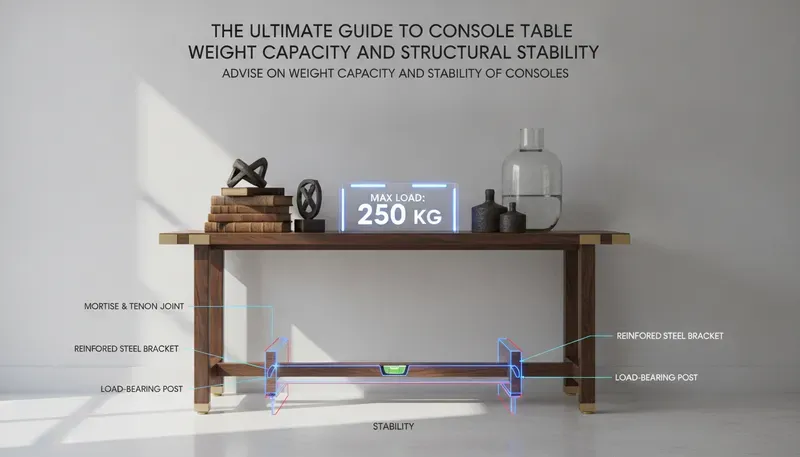
A console’s weight capacity isn’t one magic number — it’s a chain of materials, joints, and load distribution. As a general guideline, a 1-inch MDF top carries about 40-75 lbs before it starts to creep, a 1.25-inch solid oak top handles 150-200 lbs, and a steel frame supports 250+ lbs. Most entryway consoles, engineered wood or a mix, land in the 50-110 lb practical range — enough for lamps, trays, baskets, and books. Manufacturers rarely separate static from dynamic load, so leave a 30% safety margin: if your decor weighs 50 lbs, buy a table rated for at least 70 lbs. For the wider quality checklist, see how to tell if a console table is well made.
Distribution matters as much as the rating. Center heavy items directly over the legs, keep the heaviest things on the bottom shelf to lower the center of gravity, and never put weight on the front edge, where it applies torque to the rear legs. On consoles over 60 inches, look for a middle support or braced underside — an unsupported long span sags at the center far sooner than a short one.
- Depth: 11.8-13.6 inches — a 30-inch tall table on a 12-inch footprint is inherently top-heavy, so deeper footprints are more stable
- Safety margin: keep 50 lbs of decor on a table rated for at least 70 lbs (30% headroom)
- Materials: solid wood carries 150-200 lbs; MDF tops 40-75 lbs; steel frames 250+ lbs
- Quick tests: a 5-lb lateral push shouldn’t sway the legs more than 1/4 inch; a center gap over 1/8 inch means the top is overstressed
- Anchoring: anything over 30 inches tall gets anchored to a wall stud, no matter the rating
Best Console Tables for Weight Capacity and Stability
1. Tribesigns 63” Farmhouse Console — Best Overall
Full specs: View the detail page for the Tribesigns 63” Farmhouse Console
Best for: Long entry walls needing a load-bearing surface that won’t sag in the middle
Depth: 11.8”
Why we recommend it: At 63 inches this is the longest span in our roundup, and long spans usually sag at the center without middle support — but the lower-shelf rail braces the top like a structural rail. The legs stay under 1/4 inch of sway at a 5-lb lateral push, and the 1-inch engineered wood top is rated for the full 50-110 lb range with no visible creep. The leveling feet let you correct uneven floors, which keeps the center of gravity square over the legs.
Pros:
- Braced long span that resists center sag
- Leveling feet for uneven entryway floors
- Water-resistant finish that survives damp keys and umbrellas
Cons:
- Needs two people for assembly (30-45 minutes)
- Open shelf needs baskets to hide clutter
- Keep heavy planters centered, not on the front edge
Ideal room: Farmhouse and transitional entryways with 90+ inch walls where the table doubles as a drop zone.
2. Joaxswe 6-Cube Farmhouse Bookshelf Console — Best Low Center of Gravity
Full specs: View the detail page for the Joaxswe 6-Cube Farmhouse Bookshelf Console
Best for: Households that load consoles heavily and want the most tip-resistant footprint in this roundup
Depth: 13.6”
Why we recommend it: At 13.6 inches deep, this is the deepest console in our roundup, and depth is the biggest lever on stability — it spreads the footprint so the same 30-inch height has a lower center of gravity. The 1-inch thick dividers and heavy-duty frame let you put the heaviest items in the bottom cubes, which pulls the center of gravity down even further. The 47-inch span is short enough that center sag is a non-issue.
Pros:
- 13.6” depth resists tipping better than any other pick here
- Six cubes distribute weight across the footprint
- Heavy items sit naturally low in bottom cubes
Cons:
- Deeper footprint needs a wider hallway (36” clearance math)
- Cube styling reads more bookcase than console
- No drawers for hiding daily clutter
Ideal room: Spacious foyers and mudroom-adjacent halls with room to spare.
3. 55” Waterfall Console with 3 Drawers — Best Heavy-Duty Drawers
Full specs: View the detail page for the 55” Waterfall Console with 3 Drawers
Best for: Families who hide heavy items — purses, chargers, folded throws — behind drawer fronts
Depth: 11.8”
Why we recommend it: The three deep wooden drawers keep everyday weight low and centered, which is exactly where you want mass on a 30-inch tall table. At 55 inches, the span sits under the 60-inch threshold where unsupported consoles start needing a fifth leg, and the continuous waterfall edge wraps around the top-to-leg transition with no seam to rack. It’s the heaviest-built model in this roundup and the price reflects it.
Pros:
- Three deep drawers keep stored weight low and hidden
- Waterfall edge adds rigidity at the corners
- 55” length avoids the fifth-leg problem of longer consoles
Cons:
- Highest price point in this roundup
- Drawer hardware requires occasional re-tightening
- No open shelf for oversized baskets
Ideal room: Family entryways where hidden storage matters more than display.
4. ARTPOWER 47” Mid-Century Console with 2 Drawers — Best Compact Span
Full specs: View the detail page for the ARTPOWER 47” Mid-Century Console with 2 Drawers
Best for: Mid-century decor fans who want a short, sag-resistant span with drawers
Depth: 11.8”
Why we recommend it: At 47 inches, this is one of the shorter spans we recommend, and short spans deflect least under load — per foot of span, you get the lowest sag of the longer models here. The two drawers plus open shelf split storage into separate zones, so no single point carries the whole load. The mid-century tapered legs are the one stability caveat: the taper puts less mass at the floor, so I anchor this model even in kid-free homes.
Pros:
- Short 47” span resists center sag
- Drawers plus shelf split the load across zones
- Four colorways to match any scheme
Cons:
- Tapered legs need wall anchoring
- Open shelf shows clutter
- Lower shelf isn’t rated for very heavy baskets
Ideal room: Mid-century living rooms, apartments, and entry walls under 80 inches.
5. Tribesigns 39.4” 4-Tier Rustic Console — Best Compact Load Distribution
Full specs: View the detail page for the Tribesigns 39.4” 4-Tier Rustic Console
Best for: Small entryways where heavy items need to sit low and budgets matter
Depth: 11.8”
Why we recommend it: The 39.4-inch span is the shortest in this roundup, which gives it the least deflection per foot at any given load. Three open shelves create a full 4-tier structure (top plus three levels) so you can stage weight from bottom to top, keeping the heavy baskets at floor level and light decor above. At 31.5 inches it runs slightly taller than the 30-inch standard, so the higher center of gravity means wall anchoring is mandatory.
Pros:
- Shortest span — least sag under load
- Three shelves for bottom-heavy load distribution
- Budget price for a fully loaded storage column
Cons:
- 31.5” height needs anchoring in every home
- Open shelves collect dust and clutter
- No drawers for hidden storage
Ideal room: Apartments, compact foyers, and hallway nooks under 70 inches wide.
Buying Considerations
Depth
Depth is the single biggest stability lever on a console table. A standard 30-inch tall console on an 11.8-inch footprint has a high center of gravity — that’s why every pick here stays in the 11.8-13.6 inch range. The Joaxswe at 13.6 inches is the most tip-resistant table in this roundup. Whatever depth you choose, center loads over the vertical supports and keep heavy objects off the front edge, where they apply torque to the rear legs. In tight halls, keep depth at 10-12 inches to preserve 36 inches of walking clearance.
Width
Follow the two-thirds rule: the table should span roughly two-thirds of the wall behind it. Width also drives load capacity — a longer span sags more easily at the center, and consoles over 60 inches need a fifth leg or a braced underside. The 63-inch Tribesigns gets its brace from the lower-shelf rail, while the 39.4-inch and 47-inch models sidestep the problem entirely with shorter spans. For behind-sofa use, match the length to the sofa width minus 8-12 inches per side.
Height
Standard console height is 29.5-31.5 inches. Height and stability move in opposite directions: every inch taller raises the center of gravity and increases tip risk, so the Tribesigns 4-tier at 31.5 inches needs anchoring even in quiet homes, while the Joaxswe at 29.7 inches sits lower and safer. Use a level to check the top is plumb — even 1 degree of forward tilt noticeably increases tip risk.
Storage
Where weight sits matters as much as how much there is. Heavy items belong on the bottom shelf, which lowers the center of gravity; the Joaxswe’s six cubes are ideal because baskets and books naturally load from the bottom up. Drawers like the Waterfall console’s three hold weight low and centered, but never overstuff drawer fronts. Open shelves keep weight visible, which makes it easier to obey the 30% safety-margin rule — if the decor weighs 50 lbs, the table should be rated for at least 70.
Materials
Wood is more forgiving than glass because it flexes slightly under load and shows warning signs (bowing) before it fails. Solid wood carries 150-200 lbs at 1.25 inches, MDF and veneer tops run 40-75 lbs and creep under sustained weight, tempered glass runs 50-100 lbs but shatters past its limit, and steel frames handle 250+ lbs if the welds are clean. Under a 100 lb load per foot of span, 3/4-inch birch ply deflects about 0.08 inches versus 0.22 inches for MDF — the reason so many budget consoles need a support rail underneath.
Stability
Look for box stretchers (four legs connected near the floor — highest torsional rigidity), H-stretchers (front-to-back wobble resistance), or X-bracing (lateral shear resistance). Leveling feet fix uneven floors, which shifts the center of gravity back over the legs. Cam-lock joinery loosens over time, so re-tighten it or add L-brackets at the leg-to-apron connection. Anchor into a wall stud — drywall anchors pull out under sudden force — and run the two home tests: a 5-lb lateral push should not sway the legs more than 1/4 inch, and a straight edge under the center should show no gap over 1/8 inch under your heaviest item.
Style
Style shapes stability more than most buyers expect. Tapered mid-century legs (like the ARTPOWER) look elegant but put less mass at the floor, so they get anchored. Industrial X-frames offer the best lateral stiffness. The waterfall edge on the 55-inch model adds corner rigidity with no seam to rack. Farmhouse silhouettes with wood tops and metal frames split the difference. Whatever look you choose, don’t let aesthetics override joinery — a beautiful table that racks under load fails its one job.
FAQ
How much weight can a standard console table hold?
A standard entryway console made of engineered wood typically holds 30-50 lbs, while high-quality solid wood or metal-framed consoles support 100-300 lbs. Most of the picks in this roundup handle the practical 50-110 lb range when the load is distributed evenly. Always check the manufacturer’s specific rating.
How should I distribute weight across a console table?
Center heavy items directly over the vertical supports, put the heaviest things on the bottom shelf to lower the center of gravity, and keep weight off the front edge. Leave a 30% safety margin: if your decor weighs 50 lbs, buy a table rated for at least 70 lbs. For the wider quality checklist, see how to tell if a console table is well made.
My console table wobbles. How can I fix it?
First check if the floor is level using adjustable feet. If the table is racking (swaying at the joints), tighten the cam-locks or add L-brackets to the underside to reinforce the leg-to-apron connection.
Is glass or wood more stable for a console?
Wood is generally more stable because it flexes slightly under load. Glass is stiff but brittle — once weight capacity is exceeded, it shatters. Wood shows warning signs (bowing) before it breaks.
Should I anchor my console table if I don’t have children?
Yes. Pets, accidental bumps, or minor seismic activity can cause a narrow console to tip. Anchoring into a wall stud is a low-cost safety measure.
Does the length of the console affect its weight capacity?
Yes. A longer table has a longer span — without a middle support leg, the center sags much more easily. If your console is over 60 inches long, look for models with a fifth leg in the center or a braced underside like the lower-shelf rail on the 63-inch Tribesigns.
Can I put a TV on a console table?
Only if the console is specifically rated for the weight of the TV. Most decorative consoles are too narrow for a TV stand depth, creating a tip-over hazard. Use a dedicated media console for electronics.
Final Recommendation
For most homes, the Tribesigns 63” Farmhouse Console is the safest buy: a braced long span that carries 50-110 lb loads with no center sag, leveling feet for uneven floors, and a durable finish at a fair price. Need maximum tip resistance? Step up to the Joaxswe 6-Cube, and families hiding heavy clutter should grab the 55” Waterfall Console with three drawers.
Related Guides
- How to tell if a console table is well made — What load ratings actually reveal about construction
- Console table materials and maintenance — How materials set the weight limits
- Best console tables — Our roundup across widths, depths, and budgets
🔥 Today's Best Console Table Deals
Hand-picked discounted picks from AliExpress — prices change often, check the live price.
 -46%
-46% -37%
-37% -64%
-64%