
Affiliate Disclosure: EntrywayConsoleTable is reader-supported. When you buy through links on this site, we may earn a small commission at no extra cost to you.
At $60-160, the console tables we feature are engineered-wood builds with wood-grain finishes — honest wood-look pieces, not solid oak. That’s the right call at this price: engineered tops resist warping and water spots, stay dimensionally stable, and the best grain printing is hard to distinguish from real wood. Our top pick is the ARTPOWER 47-inch mid-century console.
Quick Recommendations
Here are our top wood-look console picks based on a review of more than a dozen engineered-wood models.
| Product | Best for | Depth | Storage | Price |
|---|---|---|---|---|
| ARTPOWER 47” Mid-Century 2-Drawer Console | Best wood-look finish | 11.8” | 2 drawers + 1 shelf | $110-160 |
| Tribesigns 63” Farmhouse Console | Best overall | 11.8” | 1 shelf + lower shelf | $90-140 |
| Joaxswe 6-Cube Farmhouse Console | Best for display | 13.6” | 6 cubes + top | $70-100 |
| Besiost 47” Farmhouse Wood Console | Best budget | 11.8” | 2 open shelves | $60-90 |
| 55” Waterfall Console with 3 Drawers | Best with drawers | 11.8” | 3 drawers | $130-180 |
Our #1 pick: the ARTPOWER 47” Mid-Century Console — the most convincing wood-grain finish in this lineup, with drawer storage and four color options at a fair mid-range price.
What Makes a Good Console Table?
A good console at this price tier is honest about its materials: engineered-wood panels (MDF or engineered wood with a wood-grain finish) topped with durable, water-resistant surfaces that read as wood from across the room. The frame matters most — reinforced corners and leveling feet eliminate the wobble that cheap builds develop — and the grain finish must be printed or applied cleanly enough that drawers, edges, and shelves match.
- Depth: 10-12 inches keeps a 36-inch walkway clear; 13+ inches is for spacious foyers only
- Grain realism: check drawer fronts, edges, and shelves — mismatched grain or visible edge banding is a cheap tell
- Weight: engineered consoles run 20-60 lbs vs. 50-150 lbs for solid wood — lighter is easier to move, but also easier to tip
- Durability: quality MDF and veneer tops last 10-20 years; standing water swells them permanently, so wipe spills fast
- Stability: leveling feet and anti-tip hardware are non-negotiable in busy homes
Engineered wood handles humidity better than solid wood because its cross-laminated construction barely expands or contracts, making it the smarter choice for coastal homes and seasonal climates. The trade-off is real: you can’t refinish it, so when the finish wears through, the piece is done. At $60-160, that’s an acceptable lifespan for most entryways.
Best Wood-Look Console Tables
1. ARTPOWER 47” Mid-Century 2-Drawer Console — Best Wood-Look Finish
Full specs: View the detail page for the ARTPOWER 47” Mid-Century 2-Drawer Console
Best for: Buyers who want the most convincing wood-grain look with hidden storage
Depth: 11.8”
Why we recommend it: The walnut-toned finish is the most realistic grain reproduction in this lineup at this price — the printed grain wraps the drawer fronts cleanly, and only edge-on inspection reveals it isn’t veneered solid wood. Two drawers hide keys, mail, and chargers while the open shelf handles display, and the 47-inch length satisfies the two-thirds-wall rule on most entry walls. Four colorways (brown, black, blue, green) let you match the finish to your decor without paying for a solid-wood rebuild.
Pros:
- 2 drawers plus an open shelf — the best hidden-storage mix in this roundup
- Realistic wood-grain finish available in four colors
- 47” length suits standard apartment and house entry walls
Cons:
- Wood-look finish needs gentle cleaning — skip abrasive sprays
- Engineered construction, so it can’t be refinished like solid wood
Ideal room: Mid-century and transitional entryways, apartments, and rental homes.
2. Tribesigns 63” Farmhouse Console — Best Overall
Full specs: View the detail page for the Tribesigns 63” Farmhouse Console
Best for: Standard entryways and living rooms needing a long, water-resistant wood-look surface
Depth: 11.8”
Why we recommend it: At 63 inches, this is the longest engineered-wood surface in the lineup, and the wood-grain engineered top shrugs off water spots that would mark raw pine. It is rated to hold 40 lbs of decor thanks to its reinforced frame, and the MDF-core panels stay flat through humid summers — no cupping or bowing, which solid pine slabs often show. The neutral wood tone pairs with both white farmhouse walls and dark floors.
Pros:
- Long 63” surface for lamps, trays, and statement decor
- Dimensionally stable panels resist seasonal warping
- Water-resistant finish cleans easily with a damp cloth
Cons:
- Edge banding is visible on close inspection
- Needs two people for assembly (30-45 minutes)
Ideal room: Farmhouse, modern farmhouse, and transitional entryways and open-plan living spaces.
3. Joaxswe 6-Cube Farmhouse Bookshelf Console — Best for Display
Full specs: View the detail page for the Joaxswe 6-Cube Farmhouse Bookshelf Console
Best for: Book lovers and collectors who want display space plus a tabletop
Depth: 13.6”
Why we recommend it: The six cube openings turn this console into a mini display gallery for books, baskets, and folded throws, while the 47-inch top still functions as a proper entryway surface. The 1-inch thick engineered-wood dividers and heavy-duty frame handle full book loads without flexing, and the deeper 13.6-inch footprint gives the panels more gluing surface, which makes this one of the sturdier builds in this lineup. Just be honest about the footprint — it suits foyers, not narrow halls.
Pros:
- Six cube openings for organized display storage
- 1-inch thick dividers and heavy-duty frame
- Top surface fits lamps, trays, and plants
Cons:
- 13.6” depth needs a wider hallway (36” clearance math)
- Cube styling reads more bookcase than console
Ideal room: Large foyers, reading nooks, and living-room entry walls.
4. Besiost 47” Farmhouse Wood Console — Best Budget
Full specs: View the detail page for the Besiost 47” Farmhouse Wood Console
Best for: First-time buyers and renters who want farmhouse charm under $90
Depth: 11.8”
Why we recommend it: At $60-90, this is the best value wood-look console in this roundup. The two open shelves give you real storage at a price that beats most 31-inch competitor pieces, and the wood finish reads far more expensive than the price suggests. Be clear-eyed about the trade-off: it’s an engineered-wood build with a printed grain — not solid oak — but the piece is roughly 20-30 lbs lighter than a comparable solid-wood console, which makes it far easier to move between rentals.
Pros:
- Outstanding price-to-value ratio
- Two shelves for baskets and display
- Light enough for one person to relocate
Cons:
- Lighter frame — anchor to the wall with kids or pets
- Not suitable for very heavy decor on the top surface
Ideal room: Apartments, first homes, and rental entryways where budget matters most.
5. 55” Waterfall Console with 3 Drawers — Best with Drawers
Full specs: View the detail page for the 55” Waterfall Console with 3 Drawers
Best for: Families who want to hide keys, mail, and chargers out of sight
Depth: 11.8”
Why we recommend it: The three deep drawers are the best clutter solution of any console in this lineup — everything that would land on the surface disappears behind the fronts. The waterfall edge wraps the engineered panels in one continuous line, hiding the layered edges that betray engineered construction, which makes it the cleanest material story in the lineup. At $130-180 it’s the top of this tier, but you’re paying for the most furniture-like build and the driest look.
Pros:
- Three deep drawers for hidden daily storage
- Waterfall edge hides edge banding for a seamless silhouette
- 55-inch length suits mid-size entry walls
Cons:
- Highest price point in this roundup
- Drawer hardware requires occasional re-tightening
Ideal room: Family entryways where hidden storage matters more than display.
Buying Considerations
Depth
Keep depth at 10-12 inches for hallway placement — this preserves the 36-inch walking clearance that traffic flow requires. Four of our five picks sit at 11.8 inches, which is right for most entryways. At 13.6 inches, the cube console needs a wider foyer to avoid becoming an obstacle, though the extra depth pays off in a sturdier, more gluing-surface-heavy frame.
Width
Follow the two-thirds rule: the table should span roughly two-thirds of the wall it sits against. A 47-inch table suits 70-80 inch walls; a 63-inch table suits 90-100 inch walls. For behind-sofa use, match the table length to the sofa width minus 8-12 inches on each side.
Height
Standard console height is 29.5-31.5 inches — counter height that works with door handles and eye-level mirrors. Most engineered-wood consoles sit at 30 inches, and because the panels don’t expand and contract, the height stays true year-round; solid wood tops can shift a fraction of an inch with humidity, which matters if your table butts against crown molding or a mirror frame.
Storage
Choose open shelves for display and baskets, drawers for hiding daily clutter. If you have kids or pets, drawers are the better bet — keys, mail, and dog leashes vanish instantly. Cube storage (like the Joaxswe) suits collectors who want organized display, and the ARTPOWER’s drawer-plus-shelf combo covers both needs in one footprint.
Materials
Be honest about what you’re buying: at $60-160, these are engineered-wood consoles with wood-grain finishes — MDF or particle-board cores with printed grain or veneer — not solid hardwood. Quality MDF and veneer tops last 10-20 years and resist warping better than solid wood in humid climates, but they swell permanently if standing water sits on them. Check edge banding on exposed sides, check that drawer-front grain matches the top, and look for CARB Phase 2-compliant boards. The most durable engineered option is plywood (15-25 years); avoid low-density particle board for daily use.
Stability
Look for X-bracing, metal frames, or reinforced corners, plus leveling feet for uneven floors. Engineered consoles run lighter than solid wood — 20-60 lbs versus 50-150 lbs — so anchor any console over 30 inches tall in homes with kids or pets; anti-tip hardware is cheap insurance.
Style
Choose classic silhouettes with clean lines over heavy distressing — they age better. The mid-century tapered-leg look (ARTPOWER) reads modern and timeless, the farmhouse wood-and-metal look (Tribesigns, Besiost) fits almost any home, and the waterfall edge (WF55) gives the most refined, seamless silhouette of the group. A convincing wood-grain finish beats a real but mismatched wood top every time.
FAQ
Which lasts longer, solid wood or engineered wood console tables?
Solid wood consoles last 20-50+ years with proper care, while quality engineered wood tables last 10-20 years. Solid wood can be refinished multiple times; engineered wood cannot and must be replaced when the finish wears through.
Are the console tables on this page solid wood?
No. At $60-160, these are engineered-wood builds with wood-grain finishes — MDF or engineered panels with printed grain or veneer. That’s the honest material story at this price tier, and it’s the right trade-off: dimensional stability, water resistance, and a convincing wood look for a fraction of solid-oak cost.
Can engineered wood console tables look like real wood?
Yes. High-end engineered wood uses real wood veneers that are virtually indistinguishable from solid wood — grain, color, and texture match perfectly. Only edge banding may reveal the difference on exposed sides, and good designs like the waterfall console hide it entirely.
How can I tell if a console table is solid wood or engineered?
Check exposed edges and inside drawers for end grain patterns. Solid wood shows continuous grain on edges and surfaces. Engineered wood has layered edges, repeating grain patterns, or edge banding. Weight is the fastest test — solid wood is significantly heavier than engineered alternatives.
Which material is better for humid environments?
Engineered wood handles humidity better than solid wood. Its cross-laminated construction resists expansion and contraction, making it ideal for coastal homes or climates with seasonal humidity changes. Solid wood requires climate control to prevent warping and cracking.
What is the most durable type of engineered wood for consoles?
Plywood is the most durable engineered option, with a 15-25 year lifespan — its cross-laminated layers resist warping. Quality MDF follows at 10-15 years. Avoid particle board and low-density fiberboard for console tables; they lack the durability for daily use and weight support.
Can I paint an engineered wood console table?
Yes — quality engineered wood (MDF, plywood) takes paint beautifully, often better than solid wood because the surface is more uniform. You cannot stain engineered wood to look like natural grain; the veneer is too thin. Paint is the best finish option for engineered wood.
Do solid wood console tables need special care?
Solid wood requires periodic conditioning every 6-12 months, wood-safe cleaners, and room humidity between 40-60% to prevent cracking. Engineered wood needs none of that — just dust, damp-cloth cleaning, and immediate spill cleanup. That lower maintenance burden is a real advantage for busy households.
Final Recommendation
For most homes, the ARTPOWER 47” Mid-Century 2-Drawer Console is the best buy in this tier: the most convincing wood-grain finish, drawer storage, and four color options at a fair mid-range price. Budget buyers should start with the Besiost 47”, and families with clutter problems should step up to the 55” Waterfall Console with three drawers.
Related Guides
- Rattan and Wicker Console Tables — Natural fiber alternatives
- Metal and Glass Console Tables — Luxury material options
- Smart Console Tables — Built-in charging and outlets
- Small Entryway Console Ideas — Solutions for tight spaces
🔥 Today's Best Console Table Deals
Hand-picked discounted picks from AliExpress — prices change often, check the live price.
 -64%
-64%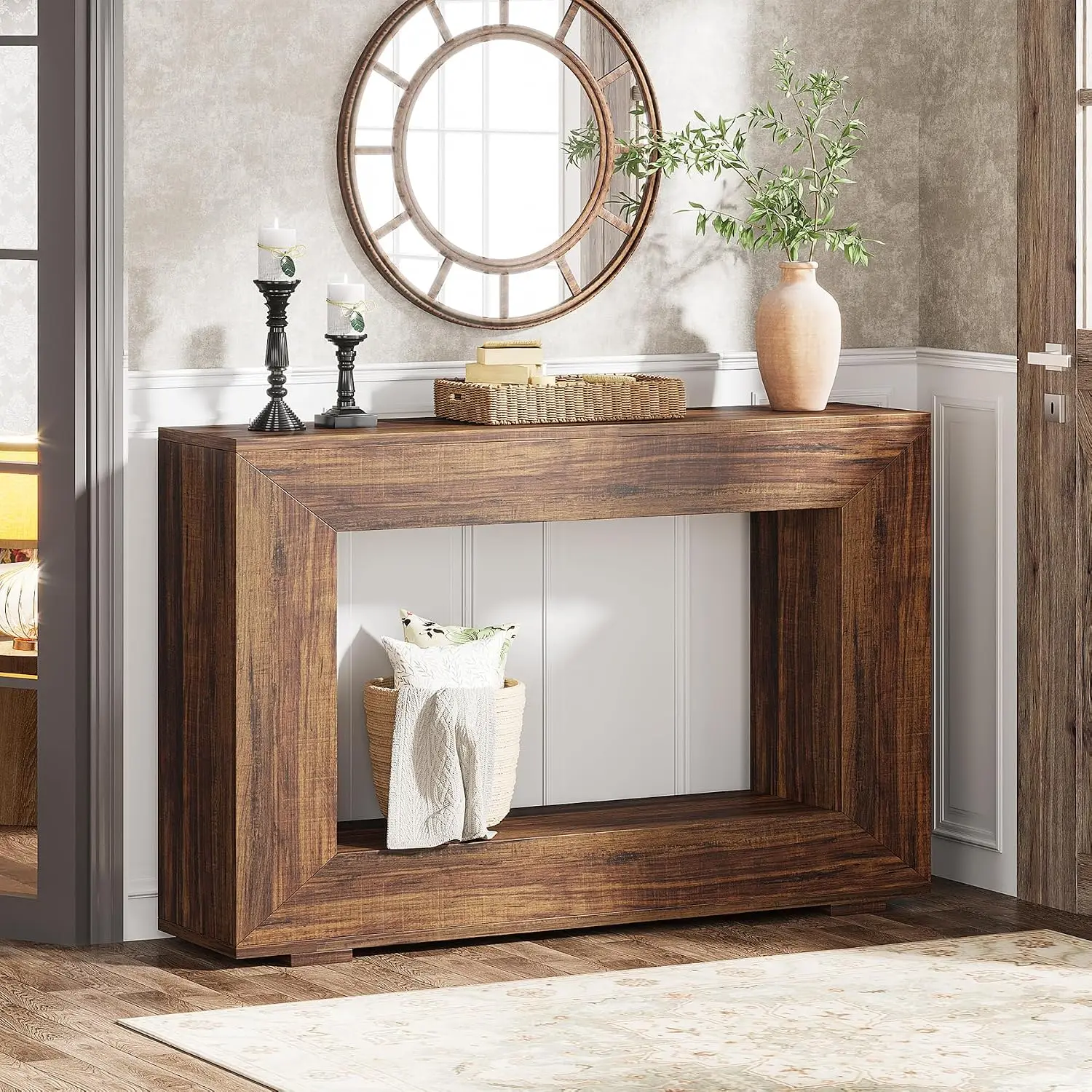 -58%
-58% -58%
-58%