
Affiliate Disclosure: EntrywayConsoleTable is reader-supported. When you buy through links on this site, we may earn a small commission at no extra cost to you.
About the author — Jessica Chen. I’ve studied traditional furniture styles extensively and helped homeowners identify quality antique and reproduction console tables.
Traditional console tables are built differently than modern pieces. They use solid hardwoods, proper joinery, and designs refined over centuries. If you want a table that lasts decades rather than years, traditional styles are worth understanding.
Here’s a breakdown of the major traditional styles and what to look for in each.
Historical Background
The term “console” comes from the French word for a bracket. Early console tables were attached to walls with S-shaped brackets, placed between windows under large mirrors to reflect light in grand rooms. Over time, they evolved into freestanding furniture.
Historical Evolution of Classic Console Styles
| Period | Style Name | Primary Characteristics | Common Materials |
|---|---|---|---|
| 1700-1750 | Queen Anne | Cabriole legs, pad feet, restrained ornamentation | Walnut, Cherry |
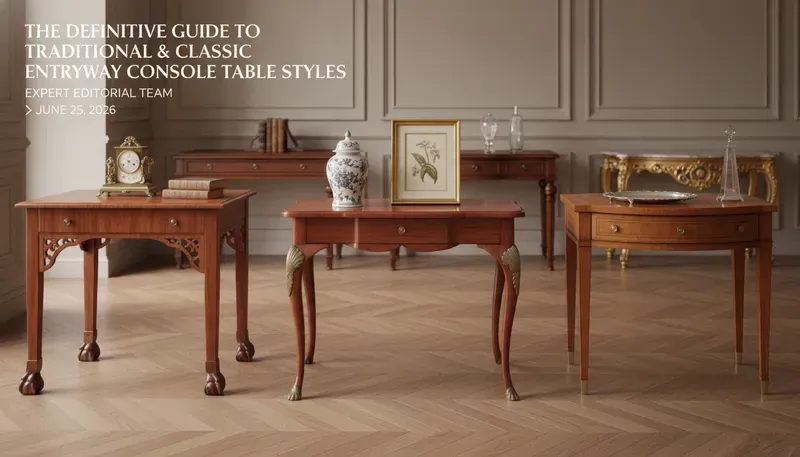
| 1750-1780 | Chippendale | Ball-and-claw feet, intricate carving, mahogany | Mahogany |
| 1780-1810 | Federal/Hepplewhite | Tapered legs, inlay, shield shapes, symmetry | Satinwood, Mahogany |
| 1830-1900 | Victorian | Heavy ornamentation, dark woods, marble tops | Rosewood, Oak, Marble |
Queen Anne Style
Queen Anne (early 18th century) is one of the most versatile traditional styles for modern entryways because of its relative simplicity.
Key Features
- Cabriole leg: An S-curve that mimics an animal leg — curves outward at the knee, inward at the ankle.
- Pad foot: A simple rounded disk foot.
- Restrained ornamentation: The beauty is in the silhouette and wood grain, not heavy carving.
If your entryway is narrow, a Queen Anne console works well. Its slender legs create visual negative space that prevents a cramped feel.
Chippendale Style
Named after Thomas Chippendale, the first cabinetmaker to publish a design book. A Chippendale console is a statement piece.
Sub-Styles
- French Influence: Rococo scrolls and acanthus leaves.
- Chinese Chippendale: Fretwork lattice on legs or aprons, reflecting 18th-century Chinoiserie trends.
- Gothic Chippendale: Pointed arches and quatrefoil carvings.
The ball-and-claw foot (a dragon’s claw clutching a pearl) is the most recognizable Chippendale feature. It adds groundedness and visual weight.
Hepplewhite and Sheraton (Neoclassical)
As the 18th century ended, design moved from Rococo curves toward Greek and Roman straight lines.
Hepplewhite features tapered legs (wide at top, narrowing toward the floor) with spade feet and contrasting wood inlays.
Sheraton is more rectilinear with fluted legs resembling Greek columns, often using satinwood for a lighter look. If your console table color scheme leans light, Sheraton pieces are a strong match.
French Provincial and Louis Styles
Louis XV (Rococo)
Heavily gilded consoles with asymmetrical carvings of shells, flowers, and vines. Best for large formal foyers.
French Provincial
Takes elegant French silhouettes and simplifies them for country homes. Usually fruitwood or oak with a scalloped apron and distressed finish.
Victorian and Gothic Revival
Victorian consoles (mid-to-late 19th century) are heavier, darker, and more imposing.
- Materials: Dark walnut, rosewood, ebony.
- Top surface: Frequently marble (white or grey-veined).
- Ornaments: Fruit, floral swags, mythological creatures.
For how these heavy pieces affect energy flow, see our guide on feng shui for console tables.
Materials and Joinery
High-end classic furniture is defined by specific technical markers.
Material Durability
| Material | Technical Grade | Aesthetic Value | Best Environment |
|---|---|---|---|
| Solid Mahogany | High Density | Deep reddish-brown, fine grain | Formal Foyers |
| Walnut | Medium-High | Spectacular burl patterns | Traditional-Modern Mix |
| Cherry | Medium | Darkens with age to a rich patina | Colonial/Early American |
| Quarter-Sawn Oak | Extremely Durable | Prominent flake or tiger grain | High-traffic entryways |
Quality Joinery Markers
- Dovetail joints: Interlocking fan-shaped joints in drawers indicate quality.
- Mortise and tenon: The standard for connecting legs to apron. Avoid tables relying solely on cam-locks.
- Veneer vs. solid: High-quality marquetry (inlaid veneers) is a sign of skill, not a negative.
Styling a Traditional Console Table
Traditional styles need a curated presentation rooted in symmetry.
The Power of Three
Place a large central object (mirror or art) flanked by two identical items (lamps or ginger jars).
Essential Components
- The anchor: Large gold-leaf or dark wood mirror hung 6-8 inches above the table.
- Lighting: Twin buffet lamps with silk shades.
- Organic element: Silver bowl of moss or vase of hydrangeas to soften the wood.
For more detail, see our console table vignette guide.
Traditional vs. New Traditional
Many manufacturers produce New Traditional pieces — classic silhouettes adapted for modern living.
| Feature | Authentic Traditional | New Traditional |
|---|---|---|
| Scale | Large, often 18”+ deep | Slimmer profiles (10-14”) |
| Finish | High-gloss lacquer or wax | Matte, wire-brushed, or cerused |
| Function | Purely aesthetic/storage | Often includes USB ports or cord management |
| Hardware | Brass, Bronze, or Porcelain | Brushed Nickel or Sleek Black |
Buyer’s Checklist
Before buying a traditional console table, check these four things:
- Verify material: Is it solid hardwood or MDF with a veneer? Solid is preferred for longevity.
- Check height: Aim for 30-33 inches for an entryway.
- Assess the finish: A quality piece should have a multi-layered finish that shows depth.
- Plan the mirror: Ensure you have enough wall space for a mirror roughly 2/3 the width of the table.
For a broader overview of all styles, see our entryway console table ultimate guide.