
Affiliate Disclosure: EntrywayConsoleTable is reader-supported. When you buy through links on this site, we may earn a small commission at no extra cost to you.
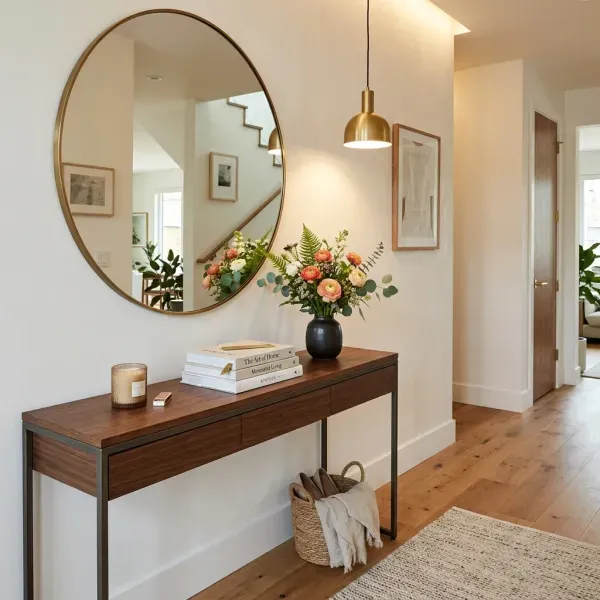
A console table is the better entryway buy for most homes: its 10-14-inch depth keeps the door path clear and its 30-32-inch height sits at drop-zone level, while a sideboard’s deeper 16-22-inch body and 32-36-inch height buy more storage at the cost of floor space. Pick a console when the entry is narrow or mostly decorative; pick a sideboard when the entry doubles as a mudroom, a dining-adjacent buffet, or a serious storage wall.
Quick Answer
Both are long, low wall pieces, and the line between them blurs — many “console tables with storage” are small sideboards in disguise. The real difference is depth and height: consoles run 10-14 inches deep and 30-32 inches tall; sideboards run 16-22 inches deep and 32-36 inches tall, with cabinets instead of open shelves. The extra depth is what buys the storage: doors need room to swing, and a cabinet needs 16 inches just to be useful.
- Depth: console 10-14” vs sideboard 16-22”
- Height: console 30-32” vs sideboard 32-36”
- Storage: console shelves and slim drawers vs sideboard cabinets and credenza storage
- Footprint: console hugs the wall; sideboard dominates the entry
Buy on the depth your entry can give up, not the name on the listing.
Console Table vs Sideboard: The Differences
| Feature | Console table | Sideboard |
|---|---|---|
| Depth | 10-14” | 16-22” |
| Height | 30-32” | 32-36” |
| Length | 30-48” typical | 47-70”+ |
| Storage | Shelves, slim drawers, baskets | Cabinets, drawers, wine/storage credenza |
| Walkway impact | Minimal | Dominates small entries |
| Entryway fit | Narrow halls, drop zones | Mudrooms, wide foyers, dining-adjacent rooms |
Shape and dimensions
The console is built to be walked past: 10-14 inches of depth leaves a 36-inch lane open in a standard hall, and its 30-32-inch height matches the natural drop-zone reach. The sideboard is built to be stood in front of: 16-22 inches of depth holds plates, bottles, and bins behind closed doors, and its 32-36-inch height works as true serving height. Length follows the same logic. Consoles typically run 30-48 inches because they serve one wall; sideboards start around 47 inches and often reach 63-70 because they serve a room. A long console on a big wall starts to blur into sideboard territory — which is exactly how many “console tables with storage” listings end up 13-16 inches deep. Full sizing rules are in our console table dimensions guide.
Storage capacity
The sideboard wins outright. Its extra 4-8 inches of depth let manufacturers fit full-height cabinets, two-deep drawers, and even wine storage, while a console’s slim body tops out at shallow drawers and open shelves. In practice, that means the console stores the daily three — keys, mail, gloves — while the sideboard stores the weekly load: sports bags, bulk paper goods, and the whole coat situation. If the entry must swallow shoes, bulk coats, and groceries, a sideboard does in two doors what a console needs baskets and hooks to fake. Storage-focused consoles narrow the gap — see our console tables with storage picks — but they stay a depth behind.
Style footprint
A console reads as furniture; a sideboard reads as furniture with a presence. The sideboard’s taller, deeper body anchors a wide wall and carries a heavier styling load — lamps, art, and a tall vase — but in a 4-foot entry it crowds the path and reads as bulky. The console’s slim silhouette keeps small entries open and lets a mirror carry the visual weight instead. The same placement logic applies to the console vs sofa table question, which we cover in console table vs sofa table.
When Each Wins in an Entryway
The console wins when: the entry is under 5 feet wide, the path needs to stay clear, the table is mostly a landing spot for keys and mail, or the wall is narrow. A console delivers the drop zone without making the room feel smaller.
The sideboard wins when: the entry is wide enough for 18-22 inches of depth plus a 36-inch lane, the table does double duty as a dining buffet, or the household needs door-concealed storage for shoes, coats, and bulk items. In a double-duty entry-dining room, a sideboard replaces two pieces of furniture.
The Verdict Framework
Answer these three questions in order, and the choice makes itself:
- Depth available. Can the entry give up 16-22 inches without choking the path? If not, the sideboard is out of the running. Console depth rules and clearance math are covered in our entryway table vs console table guide.
- Storage need. Do you need door-concealed volume — boots, bulk, bottles — or is a tray-and-basket drop zone enough? Real need for concealed volume is the only reason to eat the depth.
- Style. Is the entry a pass-through (console) or a destination wall (sideboard)? A sideboard makes a wide foyer feel furnished; a console keeps a small one feeling open.
Bottom Line
For the entryway itself, the console table is the better default: it fits more floor plans, keeps traffic moving, and covers the daily drop-zone job at a lower price. Choose a sideboard only when you have the 16-22 inches of depth to spare, the household stores real volume at the door, or the entry doubles as a dining buffet. When in doubt, measure the depth first — that single number decides the whole argument. Test it with cardboard before you buy anything; an afternoon of measuring beats a year of squeezing past.
Our Picks: Console or Sideboard
If the verdict above points to a console, these are the entryway consoles we recommend:
If You Choose a Console: HOOBRO 29.5” Narrow Console — Best Slim Entryway Console
Why we recommend it: The classic wall-hugger: 9.5 inches of depth keeps even a 4-foot entry open, one shelf takes a basket, and tool-free assembly suits renters. At $40-60 it’s the cheapest way to test whether the entry wants a table at all.
Price: $40-60
If You Choose a Console: ARTPOWER 47” Mid-Century with 2 Drawers — Best Console with Storage
Why we recommend it: The console that behaves like a mini sideboard: two wooden drawers with metal glides hide the mail pile, the open shelf takes baskets, and solid wood legs hold the 11.8-inch profile steady. For households whose clutter is small and daily, this is sideboard storage without the sideboard depth.
Price: $110-160
If the verdict points to a sideboard, these deeper pieces are the entry-sized way to get there:
If You Choose a Sideboard: Joaxswe 6-Cube Bookshelf Console — Best Entry-Sized Sideboard
Why we recommend it: Six cube bays plus a 47-inch top add up to real closed-storage potential: baskets, bins, and folded stacks fit each bay, and the 13.6-inch depth splits the difference between console and sideboard. The 1-inch-thick dividers and heavy-duty frame take a full load, and the 29.7-inch height keeps the top at reach height. At $70-100 it’s the compromise slot that wins most arguments.
Price: $70-100
If You Choose a Sideboard: Tribesigns 63” Curved Console — Best Deeper Credenza
Why we recommend it: The most sideboard-like piece we carry: a 15.75-inch depth, a 63-inch span, and a lower 23.6-inch height that reads as a credenza. Three open tiers hold baskets and bins at serving height, the curved profile softens its bulk on a wide entry wall, and the MDF construction carries heavy loads. At $110-150 it’s the pick when the entry is really a dining-adjacent room in disguise.
Price: $110-150
Real-World Entryway Scenarios (What Actually Fits)
Scenario A - 36-inch apartment hall. You have 36 inches wall to wall. Subtract 36 inches for walkway and you get zero - which is why a standard 11.8-inch console does not work here. The picks in this guide at 9.5 inches are the compromise: you keep about 26.5 inches of walkway, which is tight but passes for a single person with a bag. Add wall anchoring and keep the top to a tray and a low lamp.
Scenario B - 42-inch hall with a door swing. A 42-inch hall with a 30-inch door that swings inward needs the table on the hinge side, not the handle side, so the door clears. Max depth here is 6 inches if you keep a full 36-inch walkway. That points you at the ultra-slim 5.9-inch charging model or a wall shelf. If you can live with 32 to 34 inches of walkway, an 11.8-inch table fits and gives you a shelf.
Scenario C - 60-inch entry nook. This is the sweet spot for a 40 to 47-inch console. Two-thirds of 60 is 40, so a 40-inch or 47-inch table looks built-in. You have room for a mirror two-thirds the table width, a lamp, and a plant. Storage-wise, two shelves or two drawers hit the right density without crowding.
Scenario D - 90-inch foyer wall. Here a 63-inch table shines. Two-thirds of 90 is 60, so 63 is proportional. The longer span needs a braced underside - look for a lower-shelf rail or X-brace - otherwise the center sags under a lamp and books. Leave at least 4 to 8 inches between mirror bottom and tabletop so the composition reads as one piece.
Choosing storage vs surface. If your entry collects five things a day - keys, mail, sunglasses, dog leash, kid backpack - you need drawers. One shelf will not hide that. If your entry is mostly a visual anchor with a mail tray, open shelves with baskets are faster to use and easier to style.
Materials and maintenance. Matte water-resistant coatings hide fingerprints and wipe clean after wet umbrellas - that is why most picks use them. Solid wood can be refinished; MDF cannot, but it costs far less. In humid climates, keep indoor humidity 40 to 60 percent and seal end grain.
Stability you can test at home. After assembly, do two checks: a 5-pound lateral push at the top - sway over a quarter inch means retighten or add L-brackets. And a straight edge under the center with your heaviest decor on top - a gap over an eighth inch means the top is overstressed. Anchor any table over 30 inches tall into a stud.
Quick Measurement Worksheet
- Wall length: ______ inches x 0.66 = ideal table length. 2. Hallway width: ______ minus 36 = max depth. 3. Height: 29.5 to 31.5 inches standard. Write those three numbers and compare to the spec box above before you buy.
Common Mistakes to Avoid
Mistake 1 - Buying for the photo, not the hallway. A 14-inch deep table looks great in a staged foyer but eats 14 inches of a 38-inch hall. Always do the walkway math first. Mistake 2 - Ignoring the door swing. If the entry door swings in, a table on the handle side will get hit. Put the table on the hinge side. Mistake 3 - Forgetting anchoring. A 30-inch tall table with a 9.5-inch footprint tips easily. Use the anti-tip kit in a stud. Mistake 4 - Overloading the front edge. Weight on the front edge applies torque to the rear legs - center heavy items over the vertical supports and keep the heaviest pieces on the bottom shelf.
Finish and Care by Traffic Level
High-traffic entries with kids, pets, and wet shoes need matte water-resistant coatings - they hide fingerprints and wipe clean. Gloss and glass look premium but show dust and need weekly wiping. Solid wood can be re-oiled; MDF cannot. In sunny entries, UV fades rattan and light wood - rotate or choose a UV-stable finish. Keep humidity 40 to 60 percent; wipe spills fast; use felt pads under decor.
Price and Longevity Reality Check
An 80 dollar MDF console typically lasts 3 to 5 years before the top warps in humidity. A 120 dollar engineered wood with water-resistant top lasts 10 to 15 years. Over 200 dollars you buy solid wood and serviceable hardware. Divide price by expected years - the cheapest upfront is rarely cheapest per year. Check the listing for current price as of Aug 2026; our ranges are snapshots.
Related Guides
- Console Table Comparisons Hub — every vs. guide in one place
- Entryway Table vs Console Table — how the entryway table family fits together
- Console Table vs Sofa Table — the naming debate, settled
- Console Tables with Storage — drawer and shelf consoles that close the gap
- Console Table Dimensions — depth, height, and clearance rules
- Best Console Tables 2026 — the overall winners across every category
🔥 Today's Best Console Table Deals
Hand-picked discounted picks from AliExpress — prices change often, check the live price.
 -60%Smart Pick
 -58%
-58% -58%
-58%