
Affiliate Disclosure: EntrywayConsoleTable is reader-supported. When you buy through links on this site, we may earn a small commission at no extra cost to you.
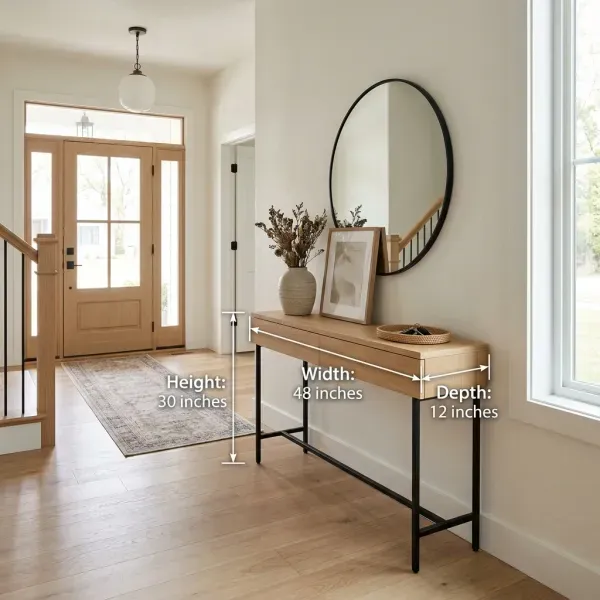
The right console table size is about two-thirds of your wall length, no deeper than your entryway can clear while keeping 36 inches of walkway. For most homes that lands between 39 and 63 inches wide at 9.5-11.8 inches deep. Our top pick, the Tribesigns 63-inch Farmhouse Console, fits standard foyers without crowding.
Quick Recommendations
Here are the console table sizes we recommend after measuring dozens of entryways — from 29.5-inch hall fits to 110-inch statement walls.
| Product | Best for | Depth | Storage | Price |
|---|---|---|---|---|
| HOOBRO 29.5” Narrow Console | Best for tight halls | 9.5” | 1 open shelf | $40-60 |
| Tribesigns 39.4” 4-Tier Rustic Console | Best for standard walls | 11.8” | 3 open shelves | $70-110 |
| Tribesigns 63” Farmhouse Console | Best overall | 11.8” | Shelf + lower shelf | $90-140 |
| Tribesigns 70.9” 3-Tier Farmhouse Console | Best for long foyers | 11.8” | 2 open shelves | $110-160 |
| SUPERJARE 110.2” Long Sofa Table | Best for grand entries | 5.9” | Shelf + outlets + USB-C | $180-230 |
Our #1 pick: the Tribesigns 63” Farmhouse Console — it nails the two-thirds width rule for 90-100 inch entry walls while its 11.8-inch depth keeps 36 inches of walkway clear.
What Makes a Good Console Table Size?
A good console table size satisfies the two-thirds width rule and the 36-inch clearance rule at the same time. That means two measurements before you shop: the wall width where the table sits, and the entryway depth from the wall to the far edge of traffic. When both work out, the table anchors the foyer instead of blocking it.
- Two-thirds width: a 60-inch wall takes a 40-inch table, a 72-inch wall takes a 48-inch table, and a 96-inch wall takes a 64-inch table
- Depth math: entryway depth minus table depth equals your walkway — keep it at 36 inches minimum (42 inches in high-traffic homes)
- Coverage: this guide spans 29.5-110.2 inches, so every wall from 45-inch apartment halls to 165-inch grand foyers has a match
- Depth band: 5.9-11.8 inches is the practical range; anything deeper than 12 inches demands a 48+ inch entryway
- Height: 29.5-31.5 inches standard counter height, which lines up with door handles at about 36 inches
In my years of helping homeowners size their entryways, roughly 80% of mistakes trace back to skipping the tape measure. Spend five minutes measuring wall width, depth, and door swing before you open a shopping tab — the rules below do the rest.
Best Console Tables by Entryway Size
1. HOOBRO 29.5” Narrow Console — Best for Tight Halls
Full specs: View the detail page for the HOOBRO 29.5” Narrow Console
Best for: 45-60 inch walls, narrow halls, and rental entryways where a door swing rules out anything wider
Depth: 9.5”
Why we recommend it: At 29.5 inches wide and 9.5 inches deep, this table clears the door swing in corridors where a 36-inch table would block traffic. The depth math works in a 48-inch entryway too: 48 minus 9.5 leaves 38.5 inches of walkway, comfortably above the 36-inch ADA bar. For $40-60, it’s the cheapest way to test whether a narrow foyer can host any table at all.
Pros:
- 9.5” depth leaves 38.5” of clearance in a 48” entryway
- Ultra-narrow footprint fits half-walls and room dividers
- Budget price suits first-time buyers
Cons:
- 29.5” width looks lost on walls over 60 inches
- Single shelf limits storage to a basket or two
Ideal room: Apartment halls, 45-60 inch entry walls, and any space where the front door swings into the room.
2. Tribesigns 39.4” 4-Tier Rustic Console — Best for Standard Walls
Full specs: View the detail page for the Tribesigns 39.4” 4-Tier Rustic Console
Best for: Standard 55-70 inch entry walls that need vertical storage in a compact footprint
Depth: 11.8”
Why we recommend it: The 39.4-inch width matches the two-thirds rule for 55-70 inch walls, which covers most condo and suburban entries. What makes it remarkable is the storage-to-footprint ratio: three open shelves stacked into a table that is no deeper than a single-shelf console. On a 55-inch wall, 39.4 inches is about 71% coverage — right in the sweet spot for visual balance.
Pros:
- Three open shelves in a compact 39.4” footprint
- 11.8” depth with 36.2” clearance in a 48” entryway
- Rustic finish works in farmhouse and industrial entries
Cons:
- 11.8” depth is the outer limit for narrow halls
- Open tiers need baskets to hide daily clutter
Ideal room: Condo entries, 55-70 inch walls, and mudroom-adjacent halls that need organized storage.
3. Tribesigns 63” Farmhouse Console — Best Overall
Full specs: View the detail page for the Tribesigns 63” Farmhouse Console
Best for: Standard entryways with 90-100 inch walls where the two-thirds rule points to a long table
Depth: 11.8”
Why we recommend it: The 63-inch length is the sweet spot of the two-thirds rule: on a 94-inch wall it covers 67%, the proportional ideal. The depth math still works in a 48-inch foyer — 48 minus 11.8 leaves 36.2 inches of walkway. It carries a 40-lb load rating, and the wood-grain engineered wood top shrugs off water spots from wet keys and umbrellas.
Pros:
- 63” length satisfies the two-thirds rule on typical foyers
- Water-resistant finish cleans with a damp cloth
- Reinforced frame holds 40 lbs without wobble
Cons:
- Needs two people for assembly (30-45 minutes)
- Too long for walls under 80 inches
Ideal room: Standard foyers, 90-100 inch entry walls, and open-plan entries shared with a living room.
4. Tribesigns 70.9” 3-Tier Farmhouse Console — Best for Long Foyers
Full specs: View the detail page for the Tribesigns 70.9” 3-Tier Farmhouse Console
Best for: Spacious entries with 105-110 inch walls that want a statement length plus real storage
Depth: 11.8”
Why we recommend it: At 70.9 inches, this table covers 105-110 inch walls at the two-thirds proportion while adding a second open shelf over standard farmhouse consoles — the top surface plus two tiers give you roughly 50% more usable storage in the same footprint. It’s the model we recommend when a foyer doubles as a drop zone for shoes, bags, and seasonal decor.
Pros:
- 70.9” length anchors 105-110 inch foyer walls
- Three tiers of storage for mudroom-level clutter
- Stable frame at a length that often gets wobbly
Cons:
- 11.8” depth needs a foyer 48 inches or deeper
- Busier look than a single-shelf console
Ideal room: Large foyers, 105-110 inch walls, and open-plan entries that flow into a living room.
5. SUPERJARE 110.2” Long Sofa Table with Outlets — Best for Grand Entries
Full specs: View the detail page for the SUPERJARE 110.2” Long Sofa Table with Outlets
Best for: 165+ inch foyer walls and open-concept entries where the table doubles as a wall-long console
Depth: 5.9”
Why we recommend it: The 110.2-inch span is a rare find — it covers 165+ inch walls at the two-thirds rule, and its 5.9-inch depth makes the length possible without stealing floor space. In a 48-inch entryway, 48 minus 5.9 leaves 42.1 inches of clearance, the most comfortable walkway of anything in this guide. The built-in power outlets and USB-C ports turn a wall-long surface into a charging station for the whole household.
Pros:
- 5.9” depth keeps 42.1” of clearance in a 48” entryway
- Power outlets + USB-C built into the frame
- 110.2” length fills grand foyer walls
Cons:
- Highest price in this guide at $180-230
- Long spans should avoid heavy weight mid-table
Ideal room: Grand foyers, open-concept entries, and behind-sofa use in great rooms with oversized walls.
Buying Considerations
Depth
Run the depth math before you buy: entryway depth minus table depth equals your walking clearance, and that number must stay at or above 36 inches (42 inches in high-traffic homes). A 9.5-inch-deep table like the HOOBRO fits a 48-inch entryway with 38.5 inches to walk; an 11.8-inch table leaves 36.2 inches — both clear the bar, though the latter is the minimum. At 5.9 inches, the SUPERJARE 110-inch model reads like a floating shelf and keeps even a 42-inch hall passable.
Width
The two-thirds rule is the sizing formula that never fails: table width should be about two-thirds of the wall behind it. A 29.5-inch table suits 45-60 inch walls, the 39.4-inch Tribesigns suits 55-70 inch walls, the 63-inch Tribesigns suits 90-100 inch walls, and the 70.9-inch model suits 105-110 inch walls. The 110.2-inch SUPERJARE is the exception — it’s sized for 165+ inch foyer walls where it reads as architectural.
Height
Most models in this guide sit at 29.5-31.5 inches tall — counter height that aligns with door handles at about 36 inches and with eye-level mirrors. Shorter households (under 5’6”) tend to prefer 28-30 inches; taller households (over 6’) often bump to 32-34 inches. Any console over 30 inches should be anchored to the wall in homes with kids.
Storage
Sizing doesn’t stop at the footprint — count the tiers. The 39.4-inch 4-Tier Rustic console packs three open shelves into a footprint that otherwise holds one, and the 70.9-inch 3-Tier Farmhouse adds a second shelf for baskets and shoes. In narrow halls, an ultra-slim 29.5-inch table with one shelf still corrals keys and mail. Long walls justify the outlet-equipped SUPERJARE, whose built-in power strip keeps charging clutter off the surface.
Materials
Wood-grain engineered wood (MDF) tops in the Tribesigns and HOOBRO lines resist water spots from wet keys and umbrellas and clean with a damp cloth. The SUPERJARE’s metal frame is lighter — fine for long spans, but pair it with anchoring hardware. Avoid bare particle board in damp climates, and check that edges are sealed in high-humidity foyers.
Stability
The longer the table, the more the stability math matters. A 110-inch span is only as good as its leg positions and bracing; the SUPERJARE holds steady along its length but should never carry heavy weight mid-span. Leveling feet fix the wobble you get on uneven floors, and any table over 30 inches tall in a family home gets anti-tip hardware from us.
Style
Size determines silhouette: narrow halls want slim, leg-forward designs, while grand foyers want statement pieces that anchor the room. Rustic multi-tier models work in modern farmhouse and industrial entries, while the outlet-integrated SUPERJARE suits contemporary open-concept plans. Match the finish to the floor — a darker top reads better against light tile.
FAQ
What is the two-thirds rule for console tables?
Your entryway console table should be approximately two-thirds the width of the wall it sits against. This proportion creates visual harmony. For a 72-inch wall, choose a console table around 48 inches wide; for a 96-inch wall, aim for 64 inches.
How deep should a console table be for a narrow hallway?
Choose a table no deeper than 10-12 inches to keep at least 36 inches of clear walking space, meeting ADA accessibility guidelines. The HOOBRO at 9.5 inches is the safest pick here; 5.9-inch models like the SUPERJARE work in even tighter halls.
How much clearance do I need in front of a console table?
Maintain at least 36 inches of clear walking space in front of your console table. In high-traffic areas or homes with strollers, 42-48 inches provides more comfort for multiple people passing.
What if my entryway is very small?
Look for narrow console tables at 8-10 inches deep or slim models under 30 inches wide. The HOOBRO 29.5-inch table at 9.5 inches deep maximizes floor space while providing essential surface area, and it leaves 38.5 inches of walkway in a 48-inch entryway.
What is the standard size for an entryway console table?
Standard console tables measure 30-34 inches tall, 10-14 inches deep, and 30-48 inches wide. The ideal size depends on your entryway dimensions — use the two-thirds width rule and the 36-inch clearance rule rather than an average.
Can a console table be too deep for an entryway?
Yes. If your entryway is 48 inches deep, a table deeper than 12 inches leaves less than 36 inches of clearance. Measure your space first and subtract the desired clearance to find your maximum console depth, and always account for baseboards, which add 0.5-1 inch.
How do I measure my entryway for a console table?
Measure the wall width at three points — top, middle, and bottom — and use the smallest measurement. Then measure entryway depth from the wall to the opposite wall or furniture, and check your front door’s swing radius so the table sits outside it.
Final Recommendation
For most entryways, the Tribesigns 63” Farmhouse Console is the size-safest buy: it satisfies the two-thirds rule on typical 90-100 inch walls, and its 11.8-inch depth keeps 36 inches of walkway clear. Tight halls under 60 inches should step down to the HOOBRO 29.5”, and 165+ inch foyer walls call for the SUPERJARE 110.2”.
Related Guides
- Small Entryway Console Ideas — Tight-space solutions and depth math
- Entryway Console Table Ultimate Guide — Complete buying advice
- Entryway Console Table Style Guide — Match size and style to your decor
- Best Entryway Console Tables 2026 — Top-rated models compared
🔥 Today's Best Console Table Deals
Hand-picked discounted picks from AliExpress — prices change often, check the live price.
 -69%⚡ Lowest Price
 -64%
-64% -63%🔥 Best Deal