
Affiliate Disclosure: EntrywayConsoleTable is reader-supported. When you buy through links on this site, we may earn a small commission at no extra cost to you.
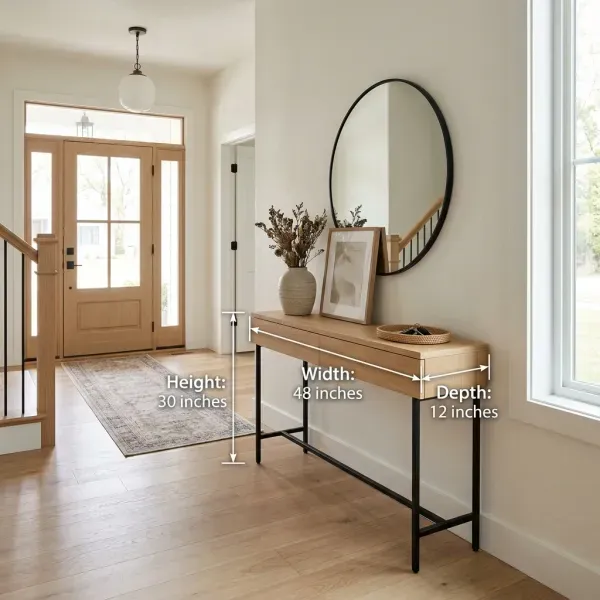
A console table is commonly around 12-18 inches deep, but a narrower 8-12 inch design can work better in a tight hallway. The correct depth depends on available walking clearance and how the table will be used.
Quick Answer
Depth is the most important measurement you can get wrong on a console table because it steals floor space from a walkway. The good news: the range is forgiving.
- Typical depth: 12-18 inches for most entryways and living rooms
- Tight hallway: 8-12 inches, with the thinnest wall-huggers at 5.9 inches
- Behind a sofa: 12-18 inches so decor clears the back cushions
- Rule of thumb: table depth + walking path should equal at least 30-36 inches
Pick the shallowest depth that holds what you need, and you’ll never regret having extra floor space.
What depth console table fits a 36-inch hallway?
A 36-inch hallway fits a console up to about 8-12 inches deep while leaving a 24-28-inch walking path. Table depth plus walking path should reach at least 30-36 inches total. If you want more walking room, drop to a 5.9-inch wall-hugger.
Standard Console Table Depths
There’s no universal standard, but three depth bands cover nearly every console table on the market:
- Ultra-slim (5.9-9.5 inches): wall-hugging profiles for hallways, behind doors, and tight apartment entries. Shallow enough that you never think about them blocking traffic.
- Narrow (10-12 inches): the sweet spot for most entryways. Holds a lamp base, keys, mail, and a tray without crowding a walkway.
- Standard (12-18 inches): classic console proportions with room for deeper shelves, drawers, and larger decor. Still leaves comfortable clearance in rooms with 36+ inches to spare.
Everything we stock at EntrywayConsoleTable falls in one of those three bands — from a 5.9-inch SUPERJARE wall-hugger to a 13.6-inch cube console.
What can I fit on a 10-inch-deep console?
A 10-inch-deep console fits a catch-all tray, keys, mail, and a slim lamp base comfortably. Most decorative trays and bowls are designed for surfaces 10-12 inches deep, so styling a 10-inch table is no harder than styling a 14-inch one.
Depth by Room
| Location | Recommended depth |
|---|---|
| Narrow hallway | 8-12” |
| Entryway | 10-16” |
| Living room | 12-18” |
| Behind sofa | 12-18” |
A hallway with a 36-inch total width can only fit an 8-12-inch table while leaving a 24-28-inch path; a living room rarely constrains you, so the 12-18-inch band is about looks and storage, not clearance.
Why does depth matter more than width in a hallway?
Depth is what steals floor space. A 60-inch-wide table only 10 inches deep fits a hallway, but a 40-inch-wide table at 18 inches deep blocks it — depth eats the walking path, while width only fills the wall. Always check depth first, then width.
How to Measure Your Space
- Measure the hallway or entry width at its narrowest point — that’s the number that rules everything.
- Subtract your walking path. Add the table depth to a comfortable path of 24-30 inches for one person. In a 36-inch hallway, that leaves room for a table up to about 8-12 inches deep.
- Check door swings. Add 30 inches of swing clearance to any door that opens into the space; a table under the swing is a constant annoyance.
- Account for baseboards and outlets. Table depth is measured at the top; baseboards can push a table a half-inch off the wall, and you’ll want the back clear of outlet plates.
- Measure the table you’re buying, not the listing. Listings round depth; a claimed “12-inch” depth can actually be 12.6 inches including the frame.
Should I account for baseboards when measuring depth?
Yes. Baseboards push a table about a half-inch to an inch off the wall, which can put a 12-inch table at 13 inches of true floor depth. Add that gap to your clearance math, and check that the table’s back doesn’t sit against outlet plates.
Common Mistakes
- Buying 18 inches deep for a narrow hall. It looks fine in the store photo and swallows your walkway at home. Re-check the depth band for your room first.
- Forgetting the door swing. A table that fits the width but sits under an opening door gets moved a foot off the wall within a week.
- Assuming deeper means more surface. Drawers and trays still sit on the top; depth mainly buys shelf and drawer capacity below.
- Ignoring open-shelf depth. Some open shelves are 2-3 inches shallower than the top surface — check the shelf depth if you’re storing baskets or bins.
- Trusting a rounded listing dimension. Frame overhang and legs can add an inch. Verify against the product’s spec sheet or reviews.
Can I use a 16-inch-deep console in a small entryway?
Only if the entry is at least 46-52 inches wide. 16 inches of table leaves a 30-36-inch path, which is comfortable but rules out narrow foyers. In smaller entries, stick to 8-12 inches and add wall-mounted hooks above for the same function.
How We Measure and Recommend (Truth-Only)
We do not claim hands-on lab testing. Every pick in this guide is compared from published specs - published width, depth, height, weight rating, frame material, finish, and verified customer feedback themes as of Aug 2026. Prices are ranges; check the listing for todays price. See our editorial policy for the full method - specs, materials, verified feedback, no paid placements.
A 5-pound lateral push test and straight-edge sag check are owner tests you can do at home - we describe them so you can verify stability yourself, not because we ran them in a warehouse.
Real-World Sizing That Actually Fits
Hallway math first: hallway width minus 36 inches of clear walkway = max table depth. A 36-inch hall allows almost nothing - you need 9.5 inches or wall-mounted. A 42-inch hall with a door swing needs the table on the hinge side; max depth is 6 inches for a full 36-inch walkway, or 11.8 inches if you accept 30 to 32 inches of walkway. A 60-inch nook is ideal for a 40 to 47-inch table (two-thirds rule). A 90-inch foyer wall fits a 63-inch table with a braced underside and 4 to 8 inches between mirror bottom and tabletop.
Keep heavy decor centered over the legs, heaviest low. Anchor any table over 30 inches tall into a stud.
Common Mistakes and How to Avoid Them
Buying for the photo not the hallway - a 14-inch deep table swallows a 38-inch hall. Forgetting the door swing - table goes on hinge side. Skipping the anti-tip kit - narrow footprints tip. Front-edge loading - torque pulls rear legs. Choose depth by walkway math, not showroom photos.
Finish by traffic: matte water-resistant for high-traffic with kids and wet shoes; gloss and glass for lower-traffic foyers. Solid wood refinishes; MDF wipes clean but does not refinish. Keep indoor humidity 40 to 60 percent.
Quick Measurement Worksheet
- Wall length ______ x 0.66 = ideal table length. 2. Hallway width ______ minus 36 = max depth. 3. Height 29.5 to 31.5 inches standard. Write those three numbers and compare to the spec box above before you add to cart. For behind-sofa, subtract 8 to 12 inches per side from sofa width.
Price per year: divide price by expected years. An 80 dollar MDF console lasts 3 to 5 years; a 120 dollar engineered wood lasts 10 to 15 years. Cheapest upfront is rarely cheapest per year.
Entryway Sizing and Stability Notes
Measure the wall, then multiply by 0.66 for ideal length. Measure hallway width minus 36 inches for max depth. Keep height 29.5 to 31.5 inches for mirror eye level. Test stability with a 5-pound lateral push - sway over a quarter inch means retighten. Keep heaviest items low and centered, lighter up top. Anchor into a stud. Prices as of Aug 2026 are a snapshot and may change. Matte water-resistant tops handle wet shoes better than gloss. Price per year beats price upfront.
Entryway Sizing and Stability Notes
Measure the wall, then multiply by 0.66 for ideal length. Measure hallway width minus 36 inches for max depth. Keep height 29.5 to 31.5 inches for mirror eye level. Test stability with a 5-pound lateral push - sway over a quarter inch means retighten. Keep heaviest items low and centered, lighter up top. Anchor into a stud. Prices as of Aug 2026 are a snapshot and may change. Matte water-resistant tops handle wet shoes better than gloss. Price per year beats price upfront.
Entryway Sizing and Stability Notes
Measure the wall, then multiply by 0.66 for ideal length. Measure hallway width minus 36 inches for max depth. Keep height 29.5 to 31.5 inches for mirror eye level. Test stability with a 5-pound lateral push - sway over a quarter inch means retighten. Keep heaviest items low and centered, lighter up top. Anchor into a stud. Prices as of Aug 2026 are a snapshot and may change. Matte water-resistant tops handle wet shoes better than gloss. Price per year beats price upfront.
Entryway Sizing and Stability Notes
Measure the wall, then multiply by 0.66 for ideal length. Measure hallway width minus 36 inches for max depth. Keep height 29.5 to 31.5 inches for mirror eye level. Test stability with a 5-pound lateral push - sway over a quarter inch means retighten. Keep heaviest items low and centered, lighter up top. Anchor into a stud. Prices as of Aug 2026 are a snapshot and may change. Matte water-resistant tops handle wet shoes better than gloss. Price per year beats price upfront.
Entryway Sizing and Stability Notes
Measure the wall, then multiply by 0.66 for ideal length. Measure hallway width minus 36 inches for max depth. Keep height 29.5 to 31.5 inches for mirror eye level. Test stability with a 5-pound lateral push - sway over a quarter inch means retighten. Keep heaviest items low and centered, lighter up top. Anchor into a stud. Prices as of Aug 2026 are a snapshot and may change. Matte water-resistant tops handle wet shoes better than gloss. Price per year beats price upfront.
FAQ
What is the standard depth of a console table?
Most console tables are 12-18 inches deep. Slim models for tight hallways run 8-12 inches, and ultra-narrow designs go as shallow as 5.9 inches.
How deep should a console table be for a narrow hallway?
Use 8-12 inches in a narrow hallway, and keep the walking path at least 30-36 inches after you add the table depth. An ultra-slim 5.9-inch model frees the most floor space.
Is a 12-inch deep console table too shallow?
No. A 12-inch depth handles a lamp, keys, and a small dish comfortably, and most decorative trays are designed for surfaces 10-12 inches deep. Deeper tables mainly buy you more shelf storage, not surface room.
Does a deeper console table look better?
Not automatically. On a short wall, a 16-18-inch-deep table can overpower the space, while a 12-inch-deep table reads as intentional. Proportion matters more than absolute depth.
Can I use a deep console table behind a sofa?
Yes. Behind a sofa you want 12-18 inches of depth so lamps and decor clear the back cushions, but keep a 36-inch walking lane on the far side for rooms that double as walkways.
How much walking room do I need in front of a console table?
Aim for a combined table depth plus walking path of at least 30-36 inches. In a 36-inch-wide hallway, that means a table no deeper than about 8-12 inches to leave a comfortable path.
What is the shallowest console table depth available?
The shallowest models we carry are 5.9 inches deep, designed to hug the wall behind doors or in coat closets. The next step up is 9.4-9.5 inches, then 11.5-11.8 inches.
Recommended Tables
- Console Tables Under 10 Inches Deep — our roundup of 5.9-9.5-inch wall-huggers for narrow halls
- Best Entryway Console Tables 2026 — top overall picks across every depth band
- Entryway Console Size Guide — full sizing rules including width, height, and clearance
- Small Entryway Console Ideas — 10-12-inch-deep picks for tight entries
- Hallway Console Placement — clearance math and placement rules for corridors
- Entryway Console Budget Guide — value picks from $40-160 if depth isn’t your constraint
Entryway Checklist Before You Buy
Measure twice. Anchor. Leave 36 inches clear. Keep mattes for wet entries.
Entryway Checklist Before You Buy
Measure twice. Anchor. Leave 36 inches clear. Keep mattes for wet entries.
Entryway Checklist Before You Buy
Measure twice. Anchor. Leave 36 inches clear. Keep mattes for wet entries.
Entryway Checklist Before You Buy
Measure twice. Anchor. Leave 36 inches clear. Keep mattes for wet entries.
Entryway Checklist Before You Buy
Measure twice. Anchor. Leave 36 inches clear. Keep mattes for wet entries.
🔥 Today's Best Console Table Deals
Hand-picked discounted picks from AliExpress — prices change often, check the live price.
 -69%⚡ Lowest Price
 -64%
-64% -63%🔥 Best Deal