
Affiliate Disclosure: EntrywayConsoleTable is reader-supported. When you buy through links on this site, we may earn a small commission at no extra cost to you.
About the author — Jessica Chen. I’ve worked with transitional design for years and found it’s the style that pleases the most people — traditional enough to feel warm, modern enough to feel current.
Transitional design sits between traditional and modern. It keeps the warmth of classic furniture while stripping away heavy ornamentation. On a console table, this means clean lines with subtle traditional details — a slight leg taper, a beveled edge, antique brass hardware on an otherwise simple silhouette.
Here’s what makes a transitional console table work and how to style one in your entryway.
What is Transitional Design?
Transitional style emerged as a reaction to both the starkness of mid-century modernism and the stiffness of formal 18th-century European styles. Designers wanted a third way — furniture that felt comfortable but not fussy.
A transitional console table typically has:
- Clean, straight lines (modern influence)
- Subtle traditional nods — tapered leg, beveled edge, warm wood tones
- A neutral color palette
Core Characteristics
1. Minimal Ornamentation
No elaborate carvings, but not just a plain box. Look for quiet details like a cove molding or a recessed drawer panel.
2. Balanced Silhouettes
A solid wood top paired with slender metal legs creates visual lightness that prevents a small entryway from feeling cramped.
3. Neutral Palettes
- Woods: Weathered oak, driftwood, walnut, espresso.
- Paints: Dove gray, charcoal, cream, greige.
- Metals: Brushed nickel, champagne bronze, matte black.
4. Texture Focus
Since the color palette is restrained, texture carries the visual interest. A wire-brushed wood finish or a stone inlay adds depth.
Material Science
| Material | Aesthetic Contribution | Durability | Best For |
|---|---|---|---|
| Solid White Oak | Warmth, visible grain, organic feel | Extremely High | High-traffic foyers |
| Tempered Glass | Modernity, transparency, lightness | Medium | Small, dark entryways |
| Polished Marble | Luxury, traditional elegance | High (but porous) | Upscale formal entries |
| Powder-Coated Steel | Industrial touch, structural strength | High | Minimalist-leaning homes |
| Reclaimed Wood | Character, sustainability, rustic history | Variable | Farmhouse-transitional |
For more on finishes, see our entryway console table woodworking guide.
Dimensions and Proportion
Standard console table dimensions for entryways:
- Height: 28 to 32 inches
- Depth: 10 to 15 inches
- Width: 36 to 60 inches
A good rule: your console should occupy about two-thirds of the wall space it sits against.
Transitional vs. Traditional vs. Modern
Traditional Console Tables
- Legs: Cabriole (curved) or heavily turned.
- Hardware: Ornate brass or glass knobs.
- Feel: Formal, heavy, authoritative.
- See our feng shui console table guide.
Modern/Minimalist Console Tables
- Legs: Simple hairpins, blocks, or floating mounts.
- Hardware: Often handle-less (push-to-open).
- Feel: Cold, industrial, purely functional.
Transitional Console Tables (The Sweet Spot)
- Legs: Tapered square legs or simple cylindrical forms.
- Hardware: Sleek but present — elongated bar pulls in matte finish.
- Feel: Approachable, timeless, collected.
Styling Your Console
A vignette for a transitional table should feel curated but not stiff.
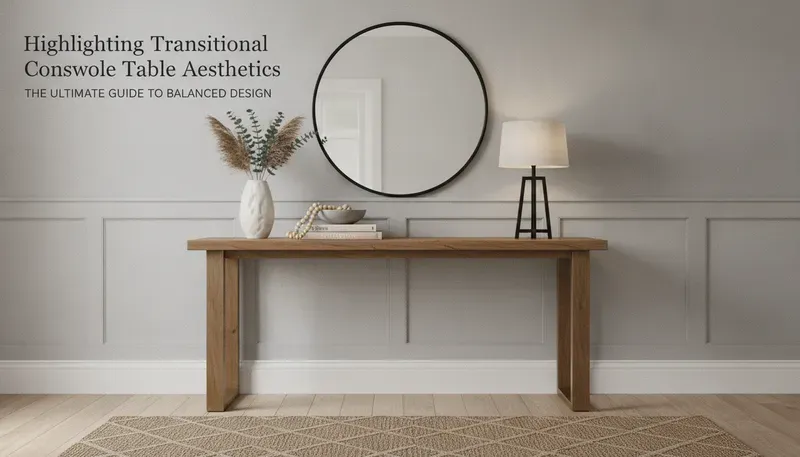
The anchor: A large mirror or abstract art hung 6-10 inches above the table. Mirrors are preferred for entryways because they bounce light.
Verticality: A tall lamp or vase with dried branches on one side prevents the table from looking flat.
The stack: Coffee table books create varying levels. A tray on top of books is a perfect spot for keys. See our console table vignette guide for more.
Color Palettes and Textural Layering
Transitional palettes are rooted in new neutrals:
- Mushroom and stone: Softer than gray, warmer than white.
- Navy and forest green: Anchoring colors that add depth without being loud.
- Mixed metals: A table with black iron legs and a brass decorative bowl looks intentional.
See our guide on console table color schemes for more.
Functional Storage
Transitional consoles often incorporate:
- Hidden drawers integrated into the apron for a slim profile.
- Lower shelving for natural fiber baskets (seagrass, rattan).
- Open bases for tucking small ottomans underneath.
| Feature | Modern Implementation | Traditional Implementation | Transitional Implementation |
|---|---|---|---|
| Drawer Pulls | Finger grooves | Decorative brass drops | Sleek geometric bars |
| Shelving | Glass or metal mesh | Solid wood with molding | Slat wood or stone inlay |
| Leg Style | Chrome cylinders | Claw and ball | Tapered Shaker style |
Lighting
Lighting is the jewelry of the entryway. Three options:
- Symmetry: Two matching lamps on each end of the table.
- Asymmetry: One lamp balanced by a tall vase on the other side.
- Sconces: Wall-mounted lights flanking the mirror keep the tabletop clear.
Maintenance
- Dusting: Microfiber cloth. Avoid silicone-based polishes that ruin matte finishes.
- Coasters: Use stone or leather coasters for damp items.
- Sunlight: UV-resistant topcoat if your entryway gets direct light.