
Affiliate Disclosure: EntrywayConsoleTable is reader-supported. When you buy through links on this site, we may earn a small commission at no extra cost to you.
I’ve tested a lot of console tables, and Asian-inspired designs consistently deliver something most other styles don’t: they make the entryway feel calmer the moment you walk in. These pieces prioritize natural materials, precise joinery, and smart use of space.
Whether you’re drawn to the rich lacquers of Chinese altar tables or the weathered textures of Japanese Wabi-Sabi, the right console table can transform a chaotic entry into a peaceful transition point.
About the author — Jessica Chen. I’ve studied Eastern furniture design traditions extensively and helped homeowners incorporate Zen-inspired pieces into both traditional and modern entryways.
Table of Contents
- The Philosophy of the Zen Entryway
- Historical Foundations: From Ming to Meiji
- Key Regional Styles
- Materiality and Craftsmanship
- Integrating Feng Shui Principles
- Design Comparison: Regional Aesthetics
- The Role of Color and Texture
- Styling Your Zen Vignette
- Size and Placement Guide
- Sustainable Choices in Asian-Inspired Furniture
- Frequently Asked Questions
The Philosophy of the Zen Entryway
Zen in interior design comes down to rejecting the superfluous. A Zen entryway console isn’t meant to demand attention through opulence. It invites your gaze into a state of rest.
The concept of Ma — negative space — is crucial here. In Western design, an empty corner is seen as a problem to solve. In Zen-inspired design, that emptiness is a functional element that lets the console table breathe. When you choose an Asian-inspired piece, you’re choosing a focal point that anchors the space without cluttering the mind.
My tip on placement: Make sure there’s at least 36 inches of clearance for walking. A Zen space should never feel tight or restrictive — physical flow supports mental flow.
Historical Foundations: From Ming to Meiji
To understand these console tables, it helps to know their origins. Asian furniture has evolved over millennia, shaped by trade, religion, and social structures.
The Ming Dynasty (1368–1644)
This period is considered the golden age of Chinese furniture. Ming consoles are characterized by simplicity without being simplistic. They use hidden joinery, such as mortise-and-tenon joints, that let the wood expand and contract without nails or glue. This structural honesty is the hallmark of the style.
The Japanese Edo and Meiji Periods
Japanese design historically focused on floor-level living, but the influence of Tansu (mobile storage) led to unique cabinetry. Modern Zen consoles often borrow from the Kaidan-dansu (staircase chests) or the minimalist aesthetic of tea houses, where every line has purpose.
Key Regional Styles
Not all Asian-inspired consoles are the same. Here’s how Chinese, Japanese, and modern Zen styles differ.
Chinese Altar Tables
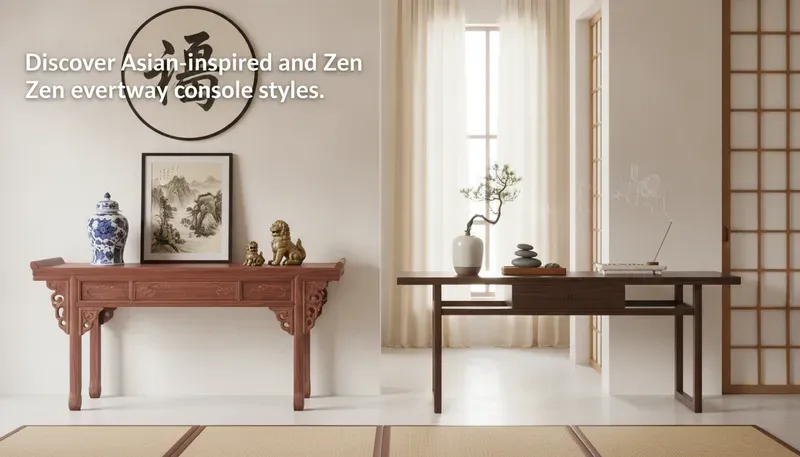
Traditionally used for honoring ancestors, these tables are long, narrow, and often feature everted ends (flanges that curve upward). Perfect for long hallways because of their slim profile.
- Best for: Dramatic, formal entryways
- Key detail: Elaborate carvings of dragons, clouds, or geometric patterns
Japanese Minimalism (Wabi-Sabi)
Wabi-Sabi celebrates the perfectly imperfect. A console in this style might feature a live-edge slab of wood, visible grain, and a low profile. It’s less about symmetry and more about the raw, organic beauty of the material.
- Best for: Modern, earthy, or bohemian-influenced homes
- Key detail: Natural oil finishes rather than high-gloss lacquer
Contemporary Zen
A fusion style that blends traditional Eastern silhouettes with Western modernism. Think clean straight lines, perhaps dark bamboo or reclaimed elm, with a sleek matte black metal frame.
- Best for: Urban apartments or transitional homes
Materiality and Craftsmanship
The materials used in Asian-inspired consoles are chosen for longevity and connection to the earth.
| Material | Aesthetic Profile | Durability | Best For |
|---|---|---|---|
| Reclaimed Elm | Rustic, textured, historical | High | Wabi-Sabi or Industrial Zen |
| Bamboo | Lightweight, sustainable, airy | Medium | Coastal or Tropical Asian styles |
| Lacquered Wood | Glossy, formal, vibrant | High (prone to scratches) | Traditional Chinese or Glamorous Zen |
| Rosewood | Rich, dark, heavy | Very High | Heirloom-quality formal pieces |
| Stone/Slate Tops | Grounded, cold, architectural | Maximum | High-traffic entryways |
The Importance of Joinery
High-quality Asian furniture avoids screws. It relies on precision woodworking. Look for dovetail or mortise-and-tenon labels in product descriptions. These techniques aren’t just decorative — they let the furniture withstand humidity changes, which is vital for pieces near a front door where air temperatures fluctuate.
For more on how materials affect the feel of your home, check our Console Table Color Schemes guide.
Integrating Feng Shui Principles
In Feng Shui, the entryway is where opportunities enter the home. Your console table should facilitate flow, not block it.
Placement Tips I’ve Found Useful:
- Avoid the mirror trap: Never place a mirror directly opposite the front door on your console. It’s believed to reflect energy right back out. Place it on a side wall instead.
- Balance the elements: If your console is dark wood (Earth/Wood), balance it with a metal bowl (Metal) or a small fountain (Water).
- Curved edges: Sharp corners direct negative energy. A console with rounded or soft edges is always preferred.
Learn more in our Feng Shui Console Table guide.
Design Comparison: Regional Aesthetics
| Feature | Traditional Chinese | Japanese Zen | Modern Fusion |
|---|---|---|---|
| Primary Color | Red, Black, Gold | Natural Wood, Grey, White | Black, Walnut, Charcoal |
| Hardware | Large brass plates/pins | Minimal or hidden | Sleek matte metal |
| Leg Style | Horse-hoof or Tapered | Straight or Block | Pedestal or Hairpin |
| Symmetry | Strictly Symmetrical | Often Asymmetrical | Balanced/Geometric |
| Atmosphere | Regal and Stately | Quiet and Organic | Sophisticated and Clean |
The Role of Color and Texture
Color in an Asian-inspired entryway is never accidental. Each hue carries weight.
- Vermillion (Red): Life, luck, and vitality. A red console table acts as a bold statement of protection.
- Black Lacquer: Depth and sophistication. Provides a grounding, elegant presence.
- Natural Oak/Elm: Growth and the Wood element. The most common choice for a Zen feel.
- Silk and Grasscloth: Often used as inserts in drawers or as backdrops to add a tactile, soft layer.
One thing I’ve learned: If you choose a dark black or espresso console, use lighting to prevent it from disappearing into the shadows. A soft warm-toned LED strip underneath creates a floating effect that works beautifully in Zen design.
Styling Your Zen Vignette
Your console table is a stage. How you dress it determines whether the space feels cluttered or curated.
The Rule of Three (Zen Version)
In Zen styling, odd numbers work best, but simplicity is key.
- The tall element: A single branch of cherry blossoms or a tall slender vase
- The grounding element: A stack of two art books or a flat stone tray
- The living element: A small bonsai or a bowl of moss
Avoid knick-knacks. Every object on the table should have personal meaning or evoke nature.
Size and Placement Guide
Measure your space before buying. Asian-inspired tables are often narrower than standard Western consoles, which is an advantage for tight entries.
| Entryway Type | Recommended Width | Recommended Depth | Style Suggestion |
|---|---|---|---|
| Narrow Hallway | 30” - 42” | 10” - 12” | Chinese Altar Style (Slim) |
| Grand Foyer | 60” - 72” | 18” - 24” | Large Sideboard or Tansu |
| Apartment Nook | 24” - 36” | 12” - 15” | Floating Zen Shelf |
Height matters: Most Asian consoles sit between 30 and 34 inches high. This is ideal for a drop zone for keys while maintaining a visual line that doesn’t overwhelm the wall.
Sustainable Choices in Asian-Inspired Furniture
Authentic Zen design is inherently sustainable because it values longevity. A well-made Asian console is an heirloom.
- Look for FSC-Certified Wood: Ensures responsible timber harvesting
- Reclaimed Elm: Many companies repurpose wood from old Northern Chinese houses. This wood is already seasoned and less likely to warp
- Water-Based Finishes: Traditional lacquers can be high in VOCs. Modern Zen pieces often use eco-friendly oils that are safer for indoor air quality
For more on durable long-lasting furniture, see our Entryway Console Table Ultimate Guide.
Frequently Asked Questions
What makes a console Zen versus just Asian-inspired?
Zen specifically refers to a minimalist, meditative aesthetic focused on naturalism and simplicity, often Japanese-influenced. Asian-inspired is a broader term that includes ornate, colorful, and regal designs from various Eastern cultures, such as Ming or Qing styles of China.
Can I mix a Zen console with a modern Western interior?
Absolutely. Zen design shares many principles with Mid-Century Modern and Scandinavian styles (often called Japandi). The clean lines and focus on wood grain allow these pieces to integrate seamlessly into most contemporary homes.
How do I maintain a lacquered finish?
Clean lacquered surfaces only with a soft damp microfiber cloth. Avoid harsh chemical cleaners or wax-based polishes, as these can cloud the finish over time.
Are altar tables practical for storage?
Traditional altar tables usually have minimal storage, perhaps one or two shallow drawers. If you need significant storage for shoes or bags, consider a Tansu-style console or a contemporary Zen sideboard instead.
What is the best wood for an Asian console?
Elm (Yumu) is the traditional choice for its beautiful grain and strength. For a more modern look, walnut or oak are excellent substitutes that provide similar weight and presence.
If you want a sense of history and regal presence, a Chinese Altar Table with sweeping lines and rich symbolism is your best choice. If you prefer the quiet unadorned beauty of nature, a Japanese Wabi-Sabi console in reclaimed wood serves as a daily reminder to find beauty in simplicity. For modern urban spaces, a Contemporary Zen fusion piece offers the best balance of Eastern philosophy and Western utility.
Related Articles: