
Affiliate Disclosure: EntrywayConsoleTable is reader-supported. When you buy through links on this site, we may earn a small commission at no extra cost to you.
A well-made console table is one that passes a five-point inspection: honest materials with sealed edges, real joinery under the panels, zero side-to-side wobble, smooth full-extension drawers, and a finish that is uniform to the touch. You can check all five in about five minutes in a store or on your doorstep — no tools required beyond your hands, your eyes, and a flat floor.
Quick Answer
Quality is not a brand name; it is a set of physical tells. Run this short version first, then read the details:
- Materials: heavy top, sealed edges, grain that wraps corners
- Joinery: glue plus screws or dowels, not staples and bare cam locks
- Stability: no wobble when pushed, thick legs, bracing on long spans
- Drawers: metal slides, full extension, aligned fronts
- Finish: uniform color, sealed edges, solid hardware
Five passes out of five and you have a keeper. Four means you are buying a compromise knowingly. Three or fewer, walk away.
Material Tells: Solid Wood vs MDF vs Particleboard
The material is the first clue, and you do not need a label to read it. Three quick tests:
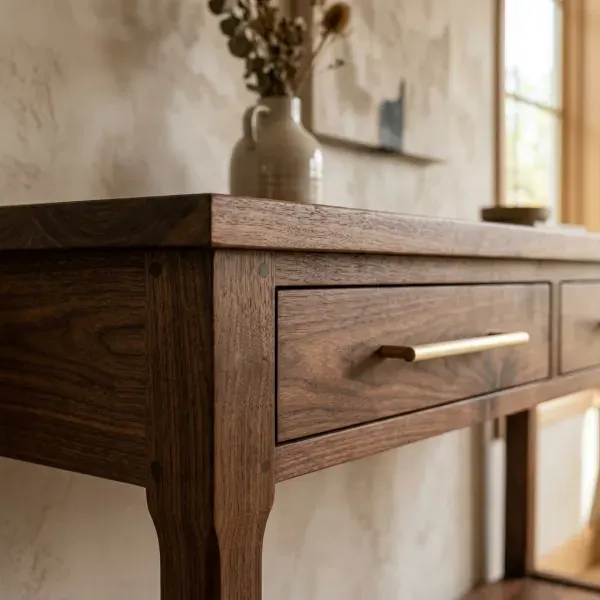
- Edge banding check. Run a fingertip along the edges of the top. A well-made engineered-wood panel has banding that blends into the surface — you can feel the seam but not catch it. Cheap panels show a visible dark line, a rough edge, or exposed particleboard where the banding stopped.
- Grain wrap. Solid wood and quality veneer show grain that wraps around corners. Particleboard and thin laminate stop dead at the edge. Identical grain on every panel in the same orientation means printed laminate — fine when sealed, a tell when peeling.
- Weight test. Lift one end of the table. A solid or thick engineered top feels heavy; a hollow honeycomb-core top feels light and drum-like. Tap it — a hollow ring is a red flag at any price.
Solid wood is the gold standard only when executed well: it should be joined, not just nailed. High-density MDF is a legitimate workhorse when it is thick (0.7 inches or more), sealed, and covered with a real wood veneer. Particleboard belongs inside panels and shelves, never in legs or frames — that is the classic table that sags in year one.
Joinery: How the Parts Hold Together
Flip the table or crawl underneath — the underside tells the truth. Look for:
- Glue plus screws or dowels in the frame — the mark of a piece built to hold. Stapled joints, staples fired into the ends of panels, are the mark of a piece built to ship.
- Cam locks are normal in flat-pack furniture and not automatically bad — what matters is whether they are tight after assembly and the joined panels feel rigid. Loose cams and rattles are the real problem.
- Drawer construction: dovetails are the traditional premium tell, but a drawer with a glued-and-screwed front and a solid bottom panel can outlast a sloppy dovetail. A thin, stapled hardboard drawer bottom is a cost cut.
- Screw blocks and brackets on tables 47 inches and up mean the maker expected the span to work. Their absence on a 60-inch table means sag is coming.
Stability Tests You Can Run in Seconds
Put the table on a flat floor and push. This is the single most reliable quality test on the list:
- Side-to-side wobble: push the top sideways with both hands. A well-made table barely moves; anything that rocks more than an inch will only get worse.
- Leg attachment: check how the legs meet the frame. Glued dowels or metal brackets with multiple screws are good; a single screw angled into particleboard is bad. Check all four corners.
- Bracing: long tables need help. An X-brace, a metal frame, or a substantial back rail keeps a 54-63-inch span from racking. Without one, treat a long table as display-only.
- Leveling feet: all four corners should have adjustable feet. They fix uneven floors, which keeps a mirror above from looking crooked.
A useful rule of thumb: the heavier the frame, the more likely it is well made — within reason.
Drawer Quality
Drawers are where budget makers hide the biggest shortcuts. Open and close every drawer:
- Slides: full-extension metal slides (ball-bearing or roller) that let the drawer come all the way out. Friction or plastic slides that stop halfway are the budget cut. Undermount slides are a premium touch — silent, smooth, nearly invisible.
- Drawer depth vs outer depth: pull the drawer fully out and measure the inside depth. A drawer much shallower than the cabinet depth is wasting space — common on budget pieces where the back panel eats the storage.
- Front alignment: with all drawers closed, run your hand across the fronts. Misaligned fronts mean sloppy tolerances.
- Anti-fall stops: a good drawer has a stop that keeps it from being pulled clean out — a small detail that says the maker considered daily use.
Finish Quality
Hold the table at eye level and look across the surfaces at an angle:
- Uniform stain or paint: color should be even across panels and between the top, sides, and legs. Blotchy areas, drips, or a shiny top with matte sides mean rushed finishing.
- Sealed edges: every edge should be sealed — including the undersides and the back of the top. Unsealed edges on engineered wood are where moisture gets in and the panel swells.
- Hardware feel: knobs should feel solid in the hand, thread on cleanly, and not wobble in their holes. Hollow-feeling, thin-plated hardware is a classic corner cut you will feel every day.
Hardware: Solid vs Plated
Metal hardware falls into two camps: solid (brass, steel, zinc) and plated (base metal with a thin coating). Test with your fingernail:
- Solid hardware has heft, a consistent tone, and shows no coating line.
- Plated hardware feels light and can chip at the edges — check the underside of the knob, where the plating is thinnest.
Also check the frame finish: powder-coated or properly painted metal should be uniform; bare spots or rust stains in the box mean it was not finished before assembly. The same standard applies to cam covers and screw caps — a maker who hides fastener heads in matching caps cares about the finished product.
Weight Capacity Expectations
A well-made table has published numbers; a cheap one hides them. Use these as benchmarks:
| Table class | Expected top capacity | What to look for |
|---|---|---|
| Budget flat-pack | 60-100 lb | Published capacity, metal frame, adjustable feet |
| Mid-range | 150-250 lb | Thick engineered top, reinforced shelves, anti-tip kit |
| Premium | 250-300+ lb | Solid wood or thick MDF, published per-shelf ratings |
If the listing gives no capacity numbers at all, treat the table with suspicion — makers who build well are proud of the numbers. From our catalog: the HOOBRO 29.5-inch rates its top at 88 lb and each shelf at 33 lb; the Lulive 55-inch rates 265 lb on the top and 220 lb on the shelf; the Tribesigns 63-inch rates 300 lb. See our weight capacity guide for the full breakdown.
Assembly Evidence: What the Box Tells You
The box tells you a lot before you build anything:
- Cam locks with proper alignment holes: cleanly drilled, consistent depth. Sloppy holes mean sloppy manufacturing.
- Numbered and labeled parts: a quality sign in flat-pack — makers that label parts expect assembly to go smoothly.
- Spare hardware: a few extra screws and cam covers are a good sign; missing hardware is a bad one.
- Damaged panels in the box: check edges and corners of every panel before you start. Swelling or chipped edges mean a rough shipment and often a rough product.
Quality is decided at the factory but delivered at your door — and two boxes of the same table can arrive in very different shape.
The 5-Point Inspection Checklist
Save this table on your phone and run it in the store or on delivery day.
| Check | What you’re testing | Pass | Fail |
|---|---|---|---|
| 1. Materials | Edges, grain, weight | Sealed edges, wrapped grain, heavy top | Exposed core, hollow ring, peeling laminate |
| 2. Joinery | Underside construction | Glue + screws or dowels, tight cams, solid drawer bottoms | Staples, rattling cams, thin hardboard bottoms |
| 3. Stability | Push test | No wobble, thick legs, X-brace or back rail, leveling feet | Sways sideways, single-screw legs, no bracing |
| 4. Drawers | Slides and alignment | Full-extension metal slides, even fronts, anti-fall stops | Friction slides, shallow depth, misaligned fronts |
| 5. Finish | Surface and hardware | Uniform color, sealed edges, solid hardware | Blotchy stain, unsealed edges, hollow knobs |
Well-Made Consoles at Every Price Point
These three tables pass the checklist at three different budgets — quality is about execution, not the price tag.
1. HOOBRO 29.5” Console with 2 Fabric Drawers — Budget Pick
Full specs: View the detail page for the HOOBRO 29.5” Console with 2 Fabric Drawers
The 29.5-inch HOOBRO does what budget tables rarely do: it publishes numbers. The top is rated at 88 lb, each mesh shelf at 33 lb, and the metal frame with four adjustable feet answers the stability questions before you ask them. The fabric drawers are the compromise — a cost cut against wood — but the frame, capacities, and leveling feet show a maker who built to spec rather than to price.
2. Lulive 55” Waterfall Console with 3 Drawers — Mid-Range Pick
Full specs: View the detail page for the Lulive 55” Waterfall Console with 3 Drawers
The Lulive 55-inch shows engineered wood done right: thickened panels, a top rated at 265 lb and a shelf at 220 lb, and a scratch-resistant finish that handles the daily drop zone. The three wooden drawers and the waterfall edge — where the side panel flows into the front — are construction details that separate a considered build from a rushed one.
3. Tribesigns 63” 3-Tier Console — Premium Pick
Full specs: View the detail page for the Tribesigns 63” 3-Tier Console
The Tribesigns 63-inch is the flat-pack table that acts like a piece of furniture: high-grade MDF, a thick tabletop rated at 300 lb, two solid shelves, and labeled parts with illustrated instructions that make assembly feel engineered. At 63 inches it also carries the two biggest stability risks — long span and heavy loads — and answers both with reinforced construction rather than luck.
Real-World Entryway Scenarios (What Actually Fits)
Scenario A - 36-inch apartment hall. You have 36 inches wall to wall. Subtract 36 inches for walkway and you get zero - which is why a standard 11.8-inch console does not work here. The picks in this guide at 9.5 inches are the compromise: you keep about 26.5 inches of walkway, which is tight but passes for a single person with a bag. Add wall anchoring and keep the top to a tray and a low lamp.
Scenario B - 42-inch hall with a door swing. A 42-inch hall with a 30-inch door that swings inward needs the table on the hinge side, not the handle side, so the door clears. Max depth here is 6 inches if you keep a full 36-inch walkway. That points you at the ultra-slim 5.9-inch charging model or a wall shelf. If you can live with 32 to 34 inches of walkway, an 11.8-inch table fits and gives you a shelf.
Scenario C - 60-inch entry nook. This is the sweet spot for a 40 to 47-inch console. Two-thirds of 60 is 40, so a 40-inch or 47-inch table looks built-in. You have room for a mirror two-thirds the table width, a lamp, and a plant. Storage-wise, two shelves or two drawers hit the right density without crowding.
Scenario D - 90-inch foyer wall. Here a 63-inch table shines. Two-thirds of 90 is 60, so 63 is proportional. The longer span needs a braced underside - look for a lower-shelf rail or X-brace - otherwise the center sags under a lamp and books. Leave at least 4 to 8 inches between mirror bottom and tabletop so the composition reads as one piece.
Choosing storage vs surface. If your entry collects five things a day - keys, mail, sunglasses, dog leash, kid backpack - you need drawers. One shelf will not hide that. If your entry is mostly a visual anchor with a mail tray, open shelves with baskets are faster to use and easier to style.
Materials and maintenance. Matte water-resistant coatings hide fingerprints and wipe clean after wet umbrellas - that is why most picks use them. Solid wood can be refinished; MDF cannot, but it costs far less. In humid climates, keep indoor humidity 40 to 60 percent and seal end grain.
Stability you can test at home. After assembly, do two checks: a 5-pound lateral push at the top - sway over a quarter inch means retighten or add L-brackets. And a straight edge under the center with your heaviest decor on top - a gap over an eighth inch means the top is overstressed. Anchor any table over 30 inches tall into a stud.
Related Guides
- Buying Guides — the hub for every console table buying question
- Console Table Features Checklist — what to check before you buy
- Console Table Weight Capacity — how much weight consoles really hold
- Solid vs Engineered Wood Console — which material is right for you
- Console Table Care Guide — keep a good table good
- Console Table Finish Guide — finishes that last
🔥 Today's Best Console Table Deals
Hand-picked discounted picks from AliExpress — prices change often, check the live price.
 -69%⚡ Lowest Price
 -64%
-64% -63%🔥 Best Deal