
Affiliate Disclosure: EntrywayConsoleTable is reader-supported. When you buy through links on this site, we may earn a small commission at no extra cost to you.
About the author — Jessica Chen. Jessica covers interior design and furniture styling for EntrywayConsoleTable.com.
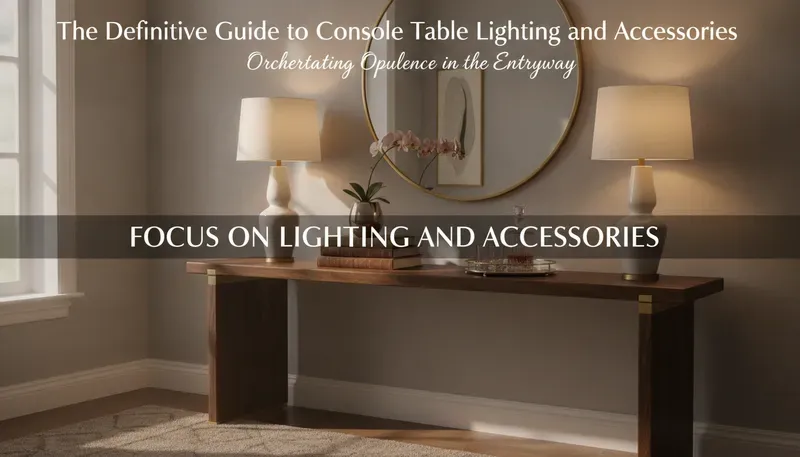
The right lighting and accessories can make a console table feel complete. I’ve found that getting this right comes down to understanding a few key principles about scale, placement, and material contrast.
Start with your light source, then build the accessories around it. A table lamp sets the height and mood. Sconces free up surface space. Mirrors double the light.
This guide covers how to choose lamps, position sconces, layer accessories, and keep cables hidden. No fluff, just what works.
Table of Contents
- The Physics of Illumination: Layering Light for Maximum Impact
- Anatomy of a Luminaire: Selecting the Perfect Table Lamp
- Wall-Mounted Brilliance: Sconces and Their Spatial Dynamics
- The Mirror Effect: Maximizing Reflective Synergy
- The Rule of Three and Beyond: Accessory Layering Principles
- Materiality and Texture: Orchestrating Visual Interest
- Functional Sophistication: Trays, Bowls, and Catch-alls
- Botanical Elegance: Integrating Living Elements
- Technical Specifications: Size, Scale, and Proportion Guide
- Seasonal Curations: Transitioning Your Console Through the Year
- Cable Management: The Hidden Art of Technical Tidiness
- Frequently Asked Questions
1. The Physics of Illumination: Layering Light for Maximum Impact
To illuminate a console table is to engage in the delicate dance of photon management. One must move beyond the utilitarian “on/off” binary and embrace the three pillars of lighting design: ambient, task, and accent lighting. In the context of an entryway, the console table serves as the primary node for accent lighting, creating a warm “glow-pool” that invites visitors inward.
The technical secret lies in the Color Rendering Index (CRI) and Color Temperature (Kelvin). For a welcoming residential environment, a Kelvin rating between 2700K and 3000K is paramount. This range mimics the golden hour of sunset, softening the wood grains of your solid oak console and flattering the complexions of arriving guests.
Expert Tip: Avoid “Cool White” bulbs (above 4000K) at all costs. They introduce a clinical, sterile atmosphere that can make even the most expensive mahogany appear ashen and lifeless.
2. Anatomy of a Luminaire: Selecting the Perfect Table Lamp
A lamp is not just a light source; it is a sculptural anchor. When selecting a lamp for a console, one must consider the Golden Ratio of height. Ideally, the lamp should stand between 1/2 to 3/4 the height of the table it sits upon. If the lamp is too diminutive, it loses its “visual authority”; if it is too gargantuan, it threatens to overwhelm the delicate craftsmanship of the furniture piece.
Table 1: Lighting Type Comparison for Console Tables
| Lighting Type | Best For | Pros | Cons |
|---|---|---|---|
| Buffet Lamps | Narrow Tables | Slim profile, elegant height | Low light spread |
| Gourd Lamps | Traditional Decor | Voluptuous shape, classic appeal | Large footprint |
| Swing-Arm | Functional Entryways | Adjustable directionality | Industrial aesthetic |
| Sculptural/Art | Minimalist Modern | Acts as a standalone art piece | Often expensive |
When evaluating the shade, consider the “translucency factor.” A silk or linen shade provides a soft, omnidirectional diffusion, while a metal or “coolie” shade focuses light downward in a dramatic cone, perfect for highlighting a reclaimed wood texture.
3. Wall-Mounted Brilliance: Sconces and Their Spatial Dynamics
For those possessing a more narrow hallway or a slim console table, wall-mounted sconces are the pinnacle of spatial efficiency. By moving the light source off the tabletop, you liberate precious square inches for botanical arrangements or heirloom accessories.
The installation height of sconces is a matter of rigorous debate among designers. However, the technical standard suggests that the center of the light source should sit approximately 60 to 64 inches from the floor. This aligns the illumination with the average human eye level, preventing glare while casting a sophisticated shadow downward toward the console surface.
Table 2: Sconce Placement Matrix
| Console Width | Sconce Configuration | Visual Effect |
|---|---|---|
| 36 - 48 Inches | Centered Pair | Symmetrical, formal, traditional |
| 48 - 72 Inches | Triple Offset | Modern, eclectic, dynamic |
| Under 36 Inches | Single Over-Center | Focused, dramatic, spotlighting |
4. The Mirror Effect: Maximizing Reflective Synergy
A console table without a mirror is like a diamond without a facet. A mirror does more than allow for a final vanity check; it acts as a light multiplier. By placing a lamp in front of a mirrored surface, you effectively double the lumen output and create a sense of infinite depth in a cramped foyer.
The Physics of Reflection: If you place a lamp with a 2700K bulb in front of a silver-backed mirror, the reflection will maintain that warm glow. However, if you use a “smoked” or “antique” mirror, the light will take on a sepia-toned, vintage character that is exceptionally luxurious. Ensure the mirror is at least 2/3 the width of the console to maintain a harmonious architectural silhouette.
5. The Rule of Three and Beyond: Accessory Layering Principles
The “Rule of Three” is the bedrock of interior styling. It suggests that objects arranged in odd numbers are more appealing, memorable, and effective than even-numbered groupings. On a console table, this translates to creating “vignettes.”
The Pyramid Formation:
- The Anchor: A tall object (Lamp or tall vase).
- The Weight: A medium-sized object (A stack of leather-bound books or a sculpture).
- The Accent: A small, low object (A decorative bowl or a cluster of candles).
Expert Tip: Vary your heights. If every object on your console is the same height, the eye has nowhere to travel, resulting in a stagnant visual experience. Use pedestals or book stacks to elevate smaller items.
6. Materiality and Texture: Orchestrating Visual Interest
To achieve a “professional-grade” look, one must embrace a high-contrast material palette. If your modern console table is made of cold, smooth marble, contrast it with the warmth of aged brass or the organic roughness of a hand-woven basket.
Table 3: Material Contrast Guide
| Console Material | Suggested Accessory Material | Why it Works |
|---|---|---|
| Dark Walnut | White Ceramic / Polished Chrome | High contrast, highlights wood grain |
| White Marble | Matte Black Iron / Dried Eucalyptus | Grounds the airiness, adds “visual weight” |
| Glass/Acrylic | Heavy Stone / Textured Fabrics | Adds “tactile soul” to transparent surfaces |
| Weathered Oak | Glass / Crystal / Silver | Elevates the rustic nature with refinement |
7. Functional Sophistication: Trays, Bowls, and Catch-alls
A console table is often the “command center” of the home. It is where keys are dropped, mail is sorted, and sunglasses are stowed. Without proper accessory management, this can quickly devolve into clutter.
The solution is the Curation Tray. A tray acts as a “frame within a frame,” signaling to the brain that the objects contained within are intentional rather than accidental. Choose a tray that complements your woodworking style—for instance, a leather-lined tray for a mid-century modern piece, or a lacquered tray for a contemporary setting.
8. Botanical Elegance: Integrating Living Elements
No console styling is complete without a “living” component. Plants provide organic curves that soften the rigid, geometric lines of the table.
- For Low Light Foyers: Use Sansevieria (Snake Plant) or Zamioculcas zamiifolia (ZZ Plant). Their architectural silhouettes are strikingly modern.
- For High Drama: A tall, slender vase with a single Monstera leaf or a handful of flowering cherry blossom branches creates height and theatricality.
- The Technicality of Drainage: Ensure all planters on wood consoles have a non-porous saucer or “cachepot” to prevent moisture from damaging the polyurethane or oil finish of your table.
9. Technical Specifications: Size, Scale, and Proportion Guide
As an authority in woodworking and interior design, I cannot emphasize enough the importance of the “Negative Space Ratio.” A common mistake is crowding the console. You should aim for approximately 30% negative space (empty space) on the tabletop. This allows the eye to rest and prevents the surface from feeling like a storage shelf.
Table 4: Proportional Standards
| Element | Recommended Proportion | Technical Rationale |
|---|---|---|
| Lamp Height | 24 - 32 Inches | Keeps light source at shoulder height |
| Accessory Height | Max 1/2 of Wall Mirror Height | Prevents blocking the reflection |
| Tray Size | 1/4 of Total Table Surface | Maintains “breathing room” |
| Lamp Shade Width | No wider than the table depth | Prevents accidental bumps in narrow halls |
10. Seasonal Curations: Transitioning Your Console Through the Year
The accessories on your console should be a living reflection of the world outside. This doesn’t mean literal “theme” decorating, but rather a subtle shift in color and texture.
- Spring/Summer: Lean into transparency. Use glass vases, white ceramics, and lighter linens. Fresh peonies or hydrangeas bring a burst of vitality.
- Autumn/Winter: Introduce “heavy” textures. Swap the linen shade for a dark velvet one. Introduce mercury glass, pinecones, or thick architectural candles to evoke a sense of warmth and protection against the cold.
11. Cable Management: The Hidden Art of Technical Tidiness
Nothing destroys the “curated opulence” of a console table faster than a tangled mess of black power cords. As a technical SEO writer and design enthusiast, I insist on invisible cable management.
- The Command Hook Method: Use clear adhesive hooks along the back of the table leg to guide the cord downward.
- The Decorative Box: Place a hollowed-out “book box” or a decorative chest next to the table to hide a power strip.
- The Under-Mount Bracket: Screw a small cable tray to the underside of the solid wood apron to tuck away excess cord length.
12. Frequently Asked Questions
How many lamps should I have on my console table?
Typically, a symmetrical pair of lamps is used for a formal, traditional look, especially on tables longer than 60 inches. For shorter tables or a more modern aesthetic, a single lamp placed on one side, balanced by a taller accessory on the other, is preferred.
What is the ideal brightness (lumens) for an entryway lamp?
For an entryway, you want “soft” light. Aim for 400 to 800 lumens. This provides enough light to find your keys but isn’t so bright that it feels harsh. Always use a dimmable bulb if your lamp allows it.
Can I put a TV above a console table?
Yes, but you must treat the TV as a piece of art. Ensure the console is wider than the TV to provide a “grounding” effect. Use low-profile accessories so as not to obstruct the screen.
How do I prevent my accessories from scratching the wood?
Always use felt pads or “bumpons” on the bottom of vases, trays, and sculptures. For high-end hand-rubbed oil finishes, avoid using rubber pads as they can react with the finish over time.
Should I match my lamp base to the table hardware?
Matching is safe, but “mixing” is professional. If your console has brass hardware, a matte black or ceramic lamp adds much more depth than another brass piece. Aim for “complementary” rather than “identical.”
Is it okay to use faux plants on a console table?
In high-end design, “real” is always preferred. However, high-quality “real-touch” silk botanicals are acceptable if the area lacks natural light. Ensure the “soil” or “water” (acrylic) looks realistic.
Written by: Jonathan Sterling, Senior Interior Designer & Woodworking Authority Fact-checked by: The EntrywayConsoleTable.com Technical Review Board
The art of the console table is an ongoing dialogue between the furniture and the objects that grace it. By applying these technical principles of lighting and accessory curation, you transform a simple entryway into a curated gallery that speaks volumes about your attention to detail and your commitment to a well-lived life.
Explore our guide on Building Your Own Console Table Learn about the History of the Console Table The Best Materials for Durable Entryway Furniture