
Affiliate Disclosure: EntrywayConsoleTable is reader-supported. When you buy through links on this site, we may earn a small commission at no extra cost to you.
The best modern console tables for 2026 pair clean lines with mixed metal and wood, all at the standard 11.8-inch depth. The Hoctieon 31.5” Curved 3-Tier is our top pick at $60-90 — a sculptural steel frame with two open shelves. For storage, the ARTPOWER Black adds two drawers and a shelf at $110-160.
Quick Recommendations
Here are our top modern and minimalist console picks, based on silhouette, materials, and value.
| Product | Best for | Depth | Storage | Price |
|---|---|---|---|---|
| Hoctieon 31.5” Curved 3-Tier | Best compact value | 11.8” | 2 open shelves | $60-90 |
| Tribesigns 39.4” White-Gold 4-Tier | Best light, bright look | 11.8” | 3 open shelves | $80-120 |
| Huuger 41.3” Curved Metal | Best sculptural frame | 11.8” | 1 open shelf | $70-100 |
| GiftGo 47.2” Vintage | Best long entryway | 11.8” | 1 open shelf | $70-100 |
| ARTPOWER 47” Black | Best with drawers | 11.8” | 2 drawers + shelf | $110-160 |
Our #1 pick: the Hoctieon 31.5” Curved 3-Tier — it delivers the modern formula of clean lines plus a sculptural metal frame at the lowest price in this roundup.
Is a curved metal frame worth paying more for?
Yes, for the right entryway. Curved steel frames like the Hoctieon at $60-90 add designer-look sculpture to a small foyer without a designer price, and powder-coated steel resists dents and cleans with a damp cloth. If your style is strictly straight-lined minimalism, a flat frame saves a few dollars, but the curved silhouette is what makes a modern table feel distinctive.
What Makes a Good Modern Console Table?
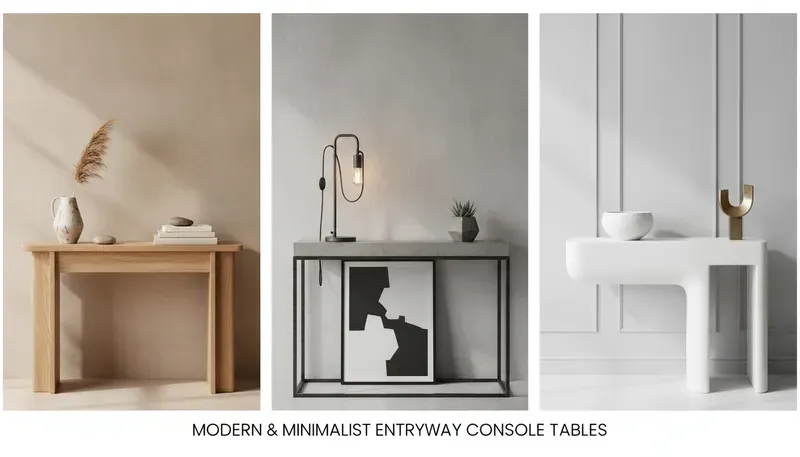
A good modern console table is silhouette-first: clean lines, minimal ornament, and a mix of metal and wood that creates visual lightness. The frame matters most — powder-coated steel or curved metal legs support a slim wood-grain top without the bulk of traditional cabinets.
- Depth: 11.8 inches is the modern standard, keeping 36-inch walkways clear
- Frames: powder-coated or curved steel resists dents and cleans with a damp cloth
- Surfaces: matte wood-grain tops hide smudges better than glossy finishes
- Storage: one or two open shelves preserve the airy look; drawers add hidden organization
- Proportions: cover 50-75% of the wall length with 6+ inches of clearance on each side
Modern design prioritizes the negative space around the furniture as much as the piece itself. A console with tapered legs or a curved metal base lets light pass through and makes a small entryway feel significantly larger — which is why the trend has moved away from storage-first pieces toward silhouette-first ones.
What is the standard depth of a modern console table?
Modern consoles run 11.8 inches deep — the standard that keeps a 36-inch walkway clear while holding a lamp base, keys, and a tray. That is narrower than traditional pieces, which commonly sit at 12-18 inches. For hallways narrower than 36 inches, step down to 8-10-inch wall-mounted options.
Best Modern Console Tables
1. Hoctieon 31.5” Curved 3-Tier — Best Compact Value
Full specs: View the detail page for the Hoctieon 31.5” Curved 3-Tier
Best for: Small foyers and hallways that need a sculptural accent
Depth: 11.8”
Why we recommend it: The curved metal frame is the most striking silhouette in this roundup, and the three tiers give you two open shelves plus the top at a compact 31.5-inch footprint. At $60-90 it brings a designer-look frame to a budget price, and the 11.8-inch depth keeps tight entryways clear.
Pros:
- Sculptural curved frame at a budget price ($60-90)
- Two open shelves for display and baskets
- 11.8” depth suits narrow halls
Cons:
- 31.5” length fails the two-thirds rule on long walls
- Open shelves expose clutter
Ideal room: Compact foyers, condo entries, and narrow hallways.
2. Tribesigns 39.4” White-Gold 4-Tier — Best Light, Bright Look
Full specs: View the detail page for the Tribesigns 39.4” White-Gold 4-Tier
Best for: Bright, airy entries with light-colored walls
Depth: 11.8”
Why we recommend it: The white-and-gold finish is the lightest, most glamorous option here, and four tiers (top plus three shelves) give you real display capacity at 11.8 inches deep. At $80-120, it is the best way to add brightness to a dark foyer without a wall-mounted unit.
Pros:
- White-gold finish brightens dark entryways
- Three open shelves for full displays
- 11.8” depth keeps walkways clear
Cons:
- Light finish shows scuffs more readily
- Four tiers read busier than minimalist singles
Ideal room: Bright entryways, glam-adjacent living rooms, and light-walled foyers.
Does a white console table get dirty quickly?
White-gold finishes brighten a dark foyer, but they show scuffs and smudges more readily than dark frames. The Tribesigns White-Gold at $80-120 stays practical because its matte wood-grain surfaces hide marks better than glossy finishes and clean up with a damp cloth. A quick weekly wipe keeps it looking gallery-bright.
3. Huuger 41.3” Curved Metal — Best Sculptural Frame
Full specs: View the detail page for the Huuger 41.3” Curved Metal
Best for: Entryways that need an artistic focal point
Depth: 11.8”
Why we recommend it: The curved metal frame gives this console genuine sculptural presence — the kind of piece that reads like art before furniture. The single open shelf keeps the design minimal, and the 41.3-inch length fits standard 60-65 inch entry walls at $70-100.
Pros:
- Artistic curved metal silhouette
- 41.3” length suits standard entry walls
- Single shelf keeps the look minimal
Cons:
- One shelf limits storage
- Curved frame may not suit formal interiors
Ideal room: Modern lofts, gallery-style foyers, and minimalist living rooms.
4. GiftGo 47.2” Vintage — Best Long Entryway
Full specs: View the detail page for the GiftGo 47.2” Vintage
Best for: Longer walls that need a modern-industrial anchor
Depth: 11.8”
Why we recommend it: At 47.2 inches, the GiftGo satisfies the two-thirds rule on 70-inch walls, making it the best proportioned option for standard suburban entryways. The vintage-modern frame blends dark metal with a rustic shelf — a cleaner take on industrial that still reads modern at $70-100.
Pros:
- Longest standard-depth pick here (47.2”)
- Vintage-modern frame suits many palettes
- Easy-clean metal and smooth shelf
Cons:
- Single open shelf limits storage
- Rustic tone leans industrial, not pure minimal
Ideal room: Suburban entryways, loft halls, and modern farmhouse-adjacent homes.
What size console fits a 70-inch entryway wall?
A console around 47 inches long covers roughly two-thirds of a 70-inch wall while leaving breathing room on each side. The GiftGo at 47.2 inches is the best-proportioned fit for standard suburban entryways, while the compact 31.5-inch Hoctieon falls short of that proportion on long walls. Keep at least 6 inches of clearance on either end.
5. ARTPOWER 47” Black — Best with Drawers
Full specs: View the detail page for the ARTPOWER 47” Black
Best for: Minimalists who still need to hide mail and keys
Depth: 11.8”
Why we recommend it: The ARTPOWER Black is the pick when clean lines meet real storage: two smooth drawers hide daily clutter while the open shelf keeps the display function. The mid-century-inspired silhouette with its 47-inch length is the most versatile modern shape in this roundup, at $110-160.
Pros:
- Two drawers for hidden storage
- Open shelf for display
- 47” length suits most entry walls
Cons:
- Priciest pick in this roundup
- Drawer fronts need regular wipe-downs
Ideal room: Minimalist foyers, modern homes, and entryways with clutter to hide.
Buying Considerations
Depth
Modern consoles run narrower than traditional pieces — 11.8 inches is the sweet spot, keeping a 36-inch walkway clear. For hallways under 36 inches wide, consider 8-10 inch floating or wall-mount options; for very open foyers, 12-14 inches is comfortable.
Width
Cover 50-75% of the wall length, leaving at least 6-10 inches of clearance on each side for visual breathing room. If the wall is six feet long, a four-foot console (like the ARTPOWER at 47”) is the ideal fit.
Height
Standard modern console height is 30-32 inches, aligning with the average person’s waist for ergonomic key drops and ideal mirror or art proportions above. Keep this band unless you need clearance for seating.
Storage
If your entryway accumulates clutter, choose a model with a slim drawer — the ARTPOWER Black hides mail and keys while keeping the clean line. If you keep surfaces clear, open shelves (Hoctieon, Tribesigns) preserve the airy silhouette that defines modern design.
Materials
Powder-coated steel frames are the modern workhorse: durable, low-maintenance, and matte-black compatible with any scheme. Wood-grain engineered tops add warmth without the water-ring risk of raw hardwoods, and tempered glass creates the illusion of space but shows fingerprints.
Stability
Thin legs are the defining feature of modern consoles, so check construction: reinforced corners, leveling feet, and wall anchoring matter more than ever on slim silhouettes. Floating consoles hold 30-50 pounds when installed into studs with heavy-duty brackets.
Do modern console tables need to be anchored to the wall?
Yes, especially in homes with kids or pets. Slim silhouettes tip more easily than bulky traditional pieces, so plan on using wall anchors with any modern console. Floating models should be mounted into wall studs with heavy-duty brackets, where they safely hold 30-50 pounds of decor and daily essentials.
Style
Modern ranges from curved sculptural frames (Hoctieon, Huuger) to white-gold glam (Tribesigns) to mid-century minimal (ARTPOWER). Natural white oak and blackened walnut are the current wood leaders — authentic, warm tones that bring texture to minimalist spaces.
What is the easiest modern finish to keep clean?
Matte wood-grain tops and powder-coated steel are the lowest-maintenance modern finishes — matte surfaces hide smudges better than glossy ones, and both wipe clean with a damp cloth. Glass tops, in contrast, show fingerprints constantly and need frequent polishing. If daily wipe-downs sound tedious, skip glass in favor of these matte metal-and-wood consoles.
FAQ
What is the best height for a modern entryway console table?
Between 30 and 32 inches. This aligns with the average person’s waist, making it ergonomic for dropping keys, and it creates ideal proportions for mirrors or art hung above.
Can I use a minimalist console in a traditional home?
Absolutely — this is transitional design. A sleek console bridges styles, bringing modern freshness to crown molding or wainscoting without clashing.
Should I choose a console with drawers or a flat top?
If your entryway accumulates mail, sunglasses, and batteries, choose a model with a slim drawer like the ARTPOWER Black. If you keep surfaces clear, open shelves or a flat top emphasize the table’s architecture.
What wood color is most modern right now?
Natural white oak and blackened walnut lead the market in 2026. Design is moving away from gray-wash woods toward authentic, warm tones that bring organic texture to minimalist spaces.
Is glass better than wood for a small foyer?
Glass creates the illusion of space because light passes through it, but it shows fingerprints and requires frequent cleaning. If you have children or pets, a slim wood or metal table like the picks above is more practical.
How long should an entryway console table be?
Cover about 50-75% of the wall’s length. If the wall is six feet long, a four-foot console (47 inches) is ideal. Leave at least six inches of clearance on either side.
How do I hide cords on a minimalist console table?
Use adhesive cable clips to run cords down the back of the leg furthest from the entrance, or use cord management boxes that match your floor finish to conceal power strips and chargers.
Final Recommendation
For most homes, the Hoctieon 31.5” Curved 3-Tier is the best modern value: a sculptural steel frame, two open shelves, and a designer silhouette at $60-90. Minimalists with clutter to hide should step up to the ARTPOWER Black for its two drawers, and bright, airy entries will love the Tribesigns White-Gold.
Related Guides
- Mirror and Art Console Pairing — Balance slim profiles with a round mirror
🔥 Today's Best Console Table Deals
Hand-picked discounted picks from AliExpress — prices change often, check the live price.
 -37%
-37% -69%⚡ Lowest Price
 -63%🔥 Best Deal