
Affiliate Disclosure: EntrywayConsoleTable is reader-supported. When you buy through links on this site, we may earn a small commission at no extra cost to you.
The best console for a large foyer spans roughly two-thirds to three-quarters of the wall length, keeps at least 3 feet of clearance on each side, and carries real storage. Our top pick is the Tribesigns 70.9” 3-Tier Farmhouse Console ($110-160), which anchors a 100-110 inch wall at just 11.8 inches deep. The SUPERJARE 110.2” is the extra-long statement alternative.
Quick Recommendations
Here are my picks for big-foyer statement consoles based on measuring walls and the scale rules in this guide.
| Product | Best for | Depth | Storage | Price |
|---|---|---|---|---|
| Tribesigns 70.9” 3-Tier Farmhouse Console | Best overall for large foyers | 11.8” | 2 open shelves | $110-160 |
| SUPERJARE 110.2” Long Sofa Table with Outlets | Extra-long statement walls | 5.9” | 1 open shelf + power outlets + USB-C | $180-230 |
| Tribesigns 63” Farmhouse Console | Classic all-rounder | 11.8” | 1 open shelf + lower shelf | $90-140 |
| Tribesigns 63” 3-Tier Farmhouse Console | Best storage | 11.8” | 2 open shelves | $90-140 |
| Huuger 54” Farmhouse Sofa Table | Best budget entry | 11.8” | 2 open shelves | $90-130 |
Our #1 pick: the Tribesigns 70.9” 3-Tier Farmhouse Console — it is the first length that stops reading as furniture and starts reading as architecture, with two shelves of storage and an 11.8-inch depth that keeps big-foyer walkways open.
What Makes a Good Large Foyer Console Table?
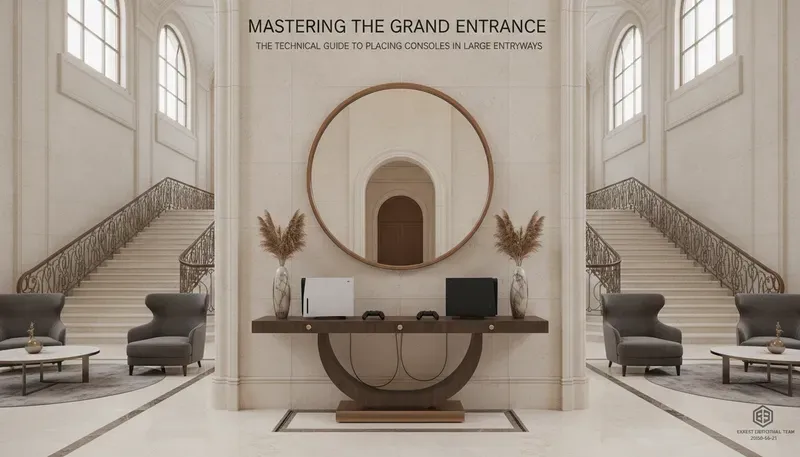
A good large-foyer console is judged by how it relates to the wall, not by the average living-room table. The biggest mistake I see is a standard 48-inch console left floating on a 10-foot wall — it looks like a toy and undermines the architecture. In grand spaces the table should cover roughly two-thirds to three-quarters of the wall length: a 100-110 inch wall wants a 70.9 to 80 inch table, and a wall of 145 inches or more is where the 110.2-inch SUPERJARE earns its keep.
Proportion only works when clearance works too. Big rooms fail when furniture blocks flow: leave at least 3 feet of open space on each side of the console and keep the main walkway at 36 inches or more. Storage and stability matter even more at length, because every wobble and every cluttered shelf is magnified across a long span.
- Length: cover two-thirds to three-quarters of the wall — a 90-inch wall needs 63 inches minimum, a 110-inch wall needs 70.9+, a 145-inch wall needs 110+
- Depth: 11.8 inches keeps a 36-inch lane clear; the 5.9-inch SUPERJARE hugs the wall for gallery-style placement
- Clearance: at least 3 feet of dead space on each side of the console and 36-48 inches of walkway in front
- Storage: two open shelves (3-tier) or a shelf plus lower shelf handle baskets, shoes, and mail at drop height
- Stability: long spans need reinforced frames, X-bracing, and leveling feet; anchor anything over 30 inches in kid-and-pet homes
Best Large Foyer Console Tables
1. Tribesigns 70.9” 3-Tier Farmhouse Console — Best Overall
Full specs: View the detail page for the Tribesigns 70.9” 3-Tier Farmhouse Console
Best for: Large foyers with 100-110 inch walls that need a statement length with real storage
Depth: 11.8”
Why we recommend it: 70.9 inches is the shortest length that reads as “designed for this space” on a 100-inch wall — it lands right at the two-thirds rule without crowding the room. The three tiers (top plus two shelves) turn the entry into a proper drop zone, and the 11.8-inch depth keeps a 48-inch foyer lane fully clear. The wood-grain finish also handles the humidity swings of front-door placement better than raw pine.
Pros:
- Statement 70.9” span that anchors big walls
- Three tiers of storage in one footprint
- 11.8” depth keeps large-foyer traffic lanes open
- Neutral farmhouse finish pairs with marble, tile, or wood floors
Cons:
- Needs two people for assembly (30-45 minutes)
- Open shelves show clutter without baskets
Ideal room: Grand foyers, open-plan entries, and gallery-style hallways with 100-110 inch walls.
2. SUPERJARE 110.2” Long Sofa Table with Outlets — Best Extra-Long
Full specs: View the detail page for the SUPERJARE 110.2” Long Sofa Table with Outlets
Best for: 145+ inch walls and double-length entries that need one continuous statement span
Depth: 5.9”
Why we recommend it: At 110.2 inches, this is the only pick that satisfies the two-thirds rule on a 150-inch wall without twinning two pieces. The 5.9-inch depth is the surprise: instead of eating the room, the table hugs the wall and leaves the foyer floor completely open — exactly what a big space needs. Built-in outlets and USB-C make it the natural home for lamps, chargers, and a landing spot for keys and phones.
Pros:
- True statement length (110.2”) for grand walls
- Slim 5.9” profile keeps walkways completely open
- Power outlets plus USB-C built into the frame
- One open shelf for baskets and low display
Cons:
- 5.9” depth suits wall-hugging layouts, not floating placement
- Highest price in this roundup ($180-230)
- No drawers — clutter needs baskets or trays
Ideal room: Double-length gallery entries and 145+ inch walls where depth must stay near zero.
3. Tribesigns 63” Farmhouse Console — Best Classic All-Rounder
Full specs: View the detail page for the Tribesigns 63” Farmhouse Console
Best for: 90-100 inch walls in large but not oversized foyers
Depth: 11.8”
Why we recommend it: 63 inches is the honest middle of the statement range: on a 95-inch wall it lands at two-thirds, and the single shelf plus lower shelf keep the look cleaner than the busier 3-tier builds. The water-resistant engineered-wood top shrugs off wet umbrellas, and the neutral tone anchored both marble-tile and wide-plank oak foyers without fighting the floor.
Pros:
- Right proportions for most large foyers (63” on 90-100” walls)
- Shelf plus lower shelf for two levels of storage
- Water-resistant finish that cleans with a damp cloth
- Long surface for a full lamp-tray-vessel vignette
Cons:
- Not a statement piece on walls over 110 inches
- Open lower shelf shows items below knee height
Ideal room: Large standard-height foyers and open entries off a great room.
4. Tribesigns 63” 3-Tier Farmhouse Console — Best Storage
Full specs: View the detail page for the Tribesigns 63” 3-Tier Farmhouse Console
Best for: Big foyers that double as family drop zones
Depth: 11.8”
Why we recommend it: The three tiers give this 63-inch table roughly 50 percent more usable storage than a standard two-tier console — enough for shoe baskets, leashes, and seasonal decor without touching the tabletop. It holds its proportion on 90-100 inch walls, and the reinforced multi-shelf frame stays stable on slightly uneven tile.
Pros:
- Three tiers of open storage in a long footprint
- Good two-thirds proportion on 90-100” walls
- Strong frame handles heavy baskets on both shelves
- Sits comfortably under $150
Cons:
- Busier silhouette than a single-shelf console
- Every tier shows clutter — baskets are essential
Ideal room: Family foyers and mudroom-adjacent entries in larger homes.
5. Huuger 54” Farmhouse Sofa Table — Best Budget Entry
Full specs: View the detail page for the Huuger 54” Farmhouse Sofa Table
Best for: Large foyers where the budget has to stay under $130
Depth: 11.8”
Why we recommend it: 54 inches is the floor of the statement range — it works on walls up to about 85 inches and still reads substantial in a large room when paired with a big mirror (75 percent of the table width) and tall lamps. Two open shelves give real storage at the cheapest price in this roundup, and the warm wood tone looks twice its price against dark floors.
Pros:
- Best value in the statement-length range ($90-130)
- Two shelves for baskets and display
- 11.8” depth keeps generous foyer lanes clear
Cons:
- Shortest pick here — undersized on walls over 90 inches
- Lighter frame; anchor it in kid-and-pet homes
Ideal room: Entryways at the small end of large, and budget-conscious big rooms.
Buying Considerations
Depth
For perimeter placement, 11.8 inches is the sweet spot: it supports lamps and trays while keeping a 36-inch lane clear. The SUPERJARE 110.2” drops to 5.9 inches, which is ideal when the console runs a long gallery wall — the table hugs the wall and the floor stays open. Deeper tables (15-24 inches) suit floating center placements, but all five picks here are perimeter pieces.
Width
Follow the two-thirds rule: the table should cover roughly two-thirds to three-quarters of its wall. A 63-inch table suits 90-100 inch walls; the 70.9-inch Tribesigns suits 100-115 inches; the 110.2-inch SUPERJARE needs a 145+ inch wall. Scale the mirror above to about 75 percent of the table width so the arrangement reads as one composition.
Height
All five picks sit at the standard 29.5-31.5 inch counter height, which works with door handles and eye-level mirrors. If your foyer has ceilings over 10 feet, don’t chase taller tables — extend the vignette upward with art or a mirror that reaches 7-8 feet from the floor to bridge the gap between furniture and ceiling.
Storage
At statement lengths, storage multiplies: the 3-tier models (Tribesigns 70.9” and 63”) offer two open shelves, the 63” classic adds a lower shelf, and the Huuger 54” carries two shelves at the best price. Baskets on the shelves hide shoes and mail at drop height, and the SUPERJARE 110.2” adds power outlets plus USB-C for chargers and lamps.
Materials
Wood-grain engineered wood (MDF) tops with water-resistant finishes are the practical choice for front-door placement — they survive humidity swings, wet umbrellas, and dropped keys better than raw pine. Metal frames add stiffness across long spans. Avoid bare particle board in damp climates, where it swells at the feet.
Stability
Length magnifies wobble. Look for reinforced frames, X-bracing, and leveling feet on every table over 60 inches — all five picks use engineered-wood tops on sturdy frames, and the 70.9” Tribesigns is rated to hold 40 lbs of decor level. Anchor any console over 30 inches tall in homes with kids or pets; anti-tip hardware is cheap insurance.
Style
In a large foyer, the console is architecture, not furniture. Keep silhouettes simple — farmhouse warmth with clean lines fits transitional and modern homes — and let the scale do the talking. Contrast with the floor: a warm wood table against marble or dark tile anchors the space, while a matching finish makes the piece disappear.
FAQ
How long should a console table be for a large foyer?
Cover roughly two-thirds to three-quarters of the wall. A 63-inch table suits 90-100 inch walls, the 70.9-inch Tribesigns suits 100-115 inch walls, and the 110.2-inch SUPERJARE is for 145+ inch walls. The most common mistake is a standard 48-inch table left floating on a 10-foot wall.
What size mirror should go above a large foyer console?
The mirror should be about 75 percent of the console’s width — too small and the table looks over-scaled, too wide and the arrangement feels unstable. In double-height foyers, extend the mirror or artwork to reach 7-8 feet from the floor.
Can I use two consoles in one large entryway?
Yes. For gallery-style entrances over 20 feet, twin identical consoles separated by at least 8-10 feet of wall space create rhythm and guide guests down the hall. If you’d rather use one piece, the 110.2-inch SUPERJARE covers the same span in a single length.
How do I hide cords in a large foyer console?
The SUPERJARE 110.2” has built-in outlets and USB-C, so lamps and chargers plug in without floor cords. For the other models, run cable clips along the back edge of the table and route wires down a rear leg, or have a floor outlet installed behind the console.
Should the console match the floor color?
Generally no — you want contrast. On dark marble or tile, a warm wood table stands out; on light oak floors, a walnut-toned piece provides the visual anchor. Matching finishes make the console disappear into the floor.
What console height works for tall ceilings?
For ceilings over 10 feet, consoles of 34-36 inches elevate the vignette into the vertical volume of the room — but all five picks here sit at the standard 30-inch height. Pair them with art or a mirror reaching 7-8 feet from the floor to achieve the same lift.
How do I light a console in a large foyer?
Layer three sources: table lamps for ambient warmth, wall sconces flanking the mirror for vertical emphasis, and an overhead chandelier or pendant for overall illumination. Mount sconces about 12 inches above the console height and 6 inches wider than the table edge on each side.
Final Recommendation
For most large foyers, the Tribesigns 70.9” 3-Tier Farmhouse Console is the buy: it’s the shortest length that reads as intentional architecture on a 100-inch wall, with two shelves of storage at a fair price. If your wall runs 145+ inches, step up to the SUPERJARE 110.2” for one continuous statement span with power built in.
Related Guides
- Console Table Materials and Maintenance — Care for wood, MDF, and metal
- Console Table Vignette Guide — Style the surface beautifully
- Modern Console Table Guide — Clean-line styling for contemporary foyers
- Mirror and Art Pairing — Scale mirrors and art to your console
- Solid vs. Engineered Wood — Which material to choose
- Console Table Lighting — Tables that support lamps and power
- Console Table Color Schemes — Match finishes to your home
🔥 Today's Best Console Table Deals
Hand-picked discounted picks from AliExpress — prices change often, check the live price.
 -63%🔥 Best Deal
 -54%
-54% -48%
-48%