
Affiliate Disclosure: EntrywayConsoleTable is reader-supported. When you buy through links on this site, we may earn a small commission at no extra cost to you.
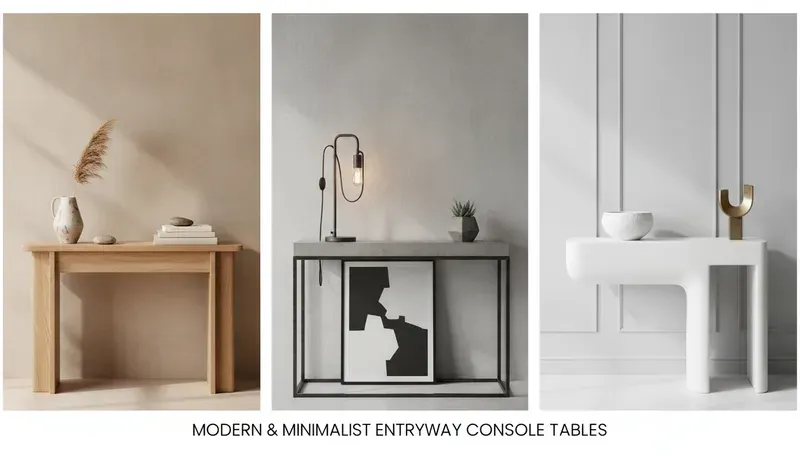
Japandi is the quietest way to furnish a loud entryway. Japanese restraint plus Scandinavian warmth gives you light oak that glows in rental light, walnut that grounds white walls, tapered legs that free floor area, and tops that stay two-thirds empty on purpose. No carving, no gloss, no themed sets — just wood grain, matte black steel, and space to breathe.
This guide covers the best Japandi entryway console tables for US homes in 2026 — minimalist natural-wood picks 31.5 to 47 inches that carry the look without custom prices. Every pick is spec-sheet analysis plus verified owner-feedback patterns. No hands-on lab testing is claimed — see our editorial policy. For modern foundations, read modern console table guide and modern console tables. For wood theory, read console table materials and solid vs engineered wood.
Best Japandi Entryway Console Tables
Minimalist natural-wood consoles for calm entries, compared by specs and owner feedback
- 1Hoctieon 31.5" Curved Console
Best compact Japandi pick with curved airy frame
- 2Besiost 47" Farmhouse Wood Console
Best long natural-wood Japandi value
- 3ARTPOWER 47" Mid-Century 2-Drawer
Best Japandi with drawers in walnut tone
- 4HOOBRO 29.5" Narrow Console
Best budget Japandi base in small halls
- 5Tribesigns 63" Long Console
Best long seamless Japandi line for wide walls
These are the Japandi consoles we recommend for calm entries.
| Product | Best for | Size (L x D x H) | Finish | Price |
|---|---|---|---|---|
| Hoctieon 31.5” Curved | Best compact | 31.5” x 11.8” x 31.5” | Rustic brown / black | $60-90 |
| Besiost 47” Farmhouse | Best long value | 47” x 11.8” x 33.5” | Black walnut wood | $60-90 |
| ARTPOWER 47” 2-Drawer | Best with drawers | 47” x 11.8” x 31.5” | Walnut mid-century | $110-160 |
| HOOBRO 29.5” Narrow | Best budget base | 29.5” x 9.5” x 31.5” | Rustic brown / black | $40-60 |
| Tribesigns 63” Long | Best wide wall | 63” x 13.8” x 33.5” | Wood / black frame | $90-140 |
Prices are US snapshots. Check live VEVOR deals before buying.
What Makes a Console Japandi
Three tests. Material is honest and matte: oak, ash, walnut-look veneer, black steel — never high-gloss lacquer or distressed barn planks. Form is low and leggy: tapered or curved legs, open air below, top that floats. Styling is negative space: 60 percent clear, one branch, one tray, one green. If a table needs five objects to look finished, it is not Japandi.
Color is warm-neutral: oatmeal, sand, light oak, soft black, one walnut anchor. Pair light-oak consoles with beige runners and black frames; pair walnut consoles with white walls and rattan baskets. Avoid navy, cherry, and orange oak — they fight the palette. For palettes, see console table color schemes and greige console tables.
The 5 Best Japandi Picks
1. Hoctieon 31.5” Curved — Best Compact Japandi
Full specs: View the detail page for the Hoctieon 31.5” Curved
Best for: 48-inch walls and studio entries that want air
Size: 31.5” L x 11.8” W x 31.5” H. Compact width with curved legs that free visual floor.
Price: $60-90. Check price on VEVOR.
Why we recommend it: The curve does Japandi work: soft geometry without ornament, open levels that stay airy, rustic-brown top that reads oak in warm light. Three levels hold tray up top, books mid, basket low — enough storage without drawers breaking the line. Build is 20 to 30-minute numbered parts.
Pros:
- Curved frame is the Japandi gesture at budget price
- 31.5 inches fits the smallest Japandi walls
- Open tiers keep the look light
Cons:
- No drawers for hiding smalls — use one lidded box
- Dark steel shows dust in side light
Style it: Round 24-inch oak mirror 6 inches above, one stem vase left, low linen tray right, one seagrass basket below. Done.
2. Besiost 47” Farmhouse Wood — Best Long Natural Value
Full specs: View the detail page for the Besiost 47” Farmhouse
Best for: 70 to 72-inch walls that want seamless wood calm
Size: 47” L x 11.8” W x 33.5” H. Longest Japandi-look value here.
Price: $60-90. Check price on VEVOR.
Why we recommend it: Black-walnut wood-look top with black frame hits the Japandi contrast without custom cost. Two full-length shelves take baskets and books in one tonal run. At 47 inches it grounds a long rental wall at two-thirds of 70 inches. Owners mention warm tone under daylight bulbs.
Pros:
- Long calm line for the money
- Walnut tone pairs with white and beige
- Two shelves for quiet volume
Cons:
- Veneer, not solid walnut — pad hot ceramics
- Light frame needs anchoring with kids
Style it: Linear oak tray centered, one low bowl, one grass stem in stone vase. Two matching baskets below, nothing else.
3. ARTPOWER 47” Mid-Century 2-Drawer — Best with Drawers
Full specs: View the detail page for the ARTPOWER 47” 2-Drawer
Best for: Entries that need hidden storage without breaking minimalism
Size: 47” L x 11.8” W x 31.5” H. Mid-century proportions that overlap Japandi cleanly.
Price: $110-160. Check price on VEVOR.
Why we recommend it: Two real wood-look drawers hide keys, mail, and chargers behind flat fronts with small pulls — the clutter solution Japandi entries need. Lower shelf holds one basket. Walnut tone plus tapered legs bridge mid-century and Japandi in US homes where both tags get searched. Per specs, drawers ride on metal runners rated for daily smalls.
Pros:
- Concealment that preserves minimalism
- Tapered legs free floor and read light
- 47 inches suits standard entries
Cons:
- Over $100 — the premium here is drawers
- 30 to 45-minute build with drawer alignment
Style it: Keep drawer fronts empty. One black tray, one white vase, 60 percent clear. Basket below in natural fiber only.
4. HOOBRO 29.5” Narrow — Best Budget Base
Full specs: View the detail page for the HOOBRO 29.5” Narrow
Best for: Tiny Japandi entries and 36-inch halls on tight budgets
Size: 29.5” L x 9.5” W x 31.5” H. Narrowest Japandi-viable base here.
Price: $40-60. Check price on VEVOR.
Why we recommend it: Rustic-brown top reads as natural wood once styled minimally; black frame supplies the Japandi line. At 9.5 inches deep it is the only pick here for 36-inch halls. Tool-free 15-minute build per owner reports. Add one oak tray and it passes for double the price in photos.
Pros:
- Fits halls nothing else fits at this price
- Fastest build, lowest price
- Wood-look top warms white rentals
Cons:
- One shelf only — minimal storage
- Light — must anchor
Style it: Single runner, small vase, nothing else on top. One basket below. Restraint is the finish.
5. Tribesigns 63” Long — Best Wide-Wall Line
Full specs: View the detail page for the Tribesigns 63” Long
Best for: 90-inch foyer walls and open-plan entries
Size: 63” L x 13.8” W x 33.5” H. Deepest here — foyers only, not 36-inch halls.
Price: $90-140. Check price on VEVOR.
Why we recommend it: A 63-inch seamless top at two-thirds of 90 inches creates the calm hotel-line Japandi entries need. Per specs, 13.8-inch depth holds large trays and art books without overhang. Use in foyers and living-room walls where depth is free; skip in narrow halls.
Pros:
- Long unbroken line calms large walls
- Deep top for art books and bowls
- Strong frame for heavy decor
Cons:
- Too deep for halls under 48 inches
- Needs a 90-inch wall to avoid crowding
Style it: Two zones with 24 inches of empty between: tray zone and stem zone. One low bench or basket below, centered.
Sizing a Japandi Entry: 31.5 to 63 Inches
Wall times 0.66. Hall minus 36 for max depth. Height 29.5 to 33.5 inches.
- 48-inch wall: 31.5-inch console, 11.8-inch deep max in 44-inch halls. Picks 1 and 4.
- 60 to 63-inch wall: 41.8 to 47-inch console. Picks 2 and 3.
- 90-inch wall: 60 to 63-inch console. Pick 5.
- Mirror: 50 to 75 percent of table width, 4 to 8 inches above. Round rattan or thin oak frames read most Japandi. Details in console table and mirror size guide.
For narrow-hall math, see best narrow console tables, best console tables for narrow hallways, and best narrow console tables under $100. For small layouts, see best small console tables and best small entryway tables with storage.
Materials That Read Japandi vs Ones That Fight It
Reads Japandi: white oak veneer, light ash, walnut-look matte, black powder-coated steel, rattan cane, linen, stoneware, seagrass. Fights it: high-gloss lacquer, distressed barn gray, cherry red, mirrored fronts, crystal knobs, carved legs. At $60 to $160 you buy veneer over steel — keep it matte, keep humidity 40 to 60 percent, pads under everything, no dragging. Solid oak Japandi at $300-plus can be re-oiled; veneer cannot be refinished, only replaced in 3 to 5 years in busy entries. Background in console table materials, metal glass consoles, and rattan wicker console.
Styling Without Clutter: The 60 Percent Rule
Keep 60 percent of the top empty. Left to right: tall (branch 24 to 30 inches), mid (tray 12 by 8 inches for mail and sunglasses), low (bowl 6 inches for keys). Below: one basket, not three. Above: one mirror or one art frame, never both competing. Light: one lamp or one wall wash, 2700K warm. Green: one stem — eucalyptus, olive, or dried grass. More ideas in console table decor ideas, console table vignette guide, mirror art console pairing, and console table lighting.
Care, Anchoring, and Rental Notes
Anchor over-30-inch tables to studs; strap rentals rated 50 pounds. Wipe oak-look tops with damp microfiber only — no harsh chemicals that cloud matte. Felt pads under every object. Rotate sun-side decor monthly; UV grays light veneer unevenly. Entry humidity from wet coats needs airflow — open shelves dry faster than closed cabinets. Full care in console table care guide and console table finish guide.
Japandi vs Scandi vs Minimalist vs Mid-Century: Which Tag Fits Your Search
Shoppers type four nearby keywords for the same calm table. Use this split to avoid buying the wrong vibe. Japandi means low-contrast warmth: light oak or walnut plus black steel, curved or tapered legs, matte, one natural texture like rattan or linen. Scandi means brighter white-oak minimalism with higher legs and paler textiles — better for dark north-facing US apartments that need bounce. Minimalist alone means fewer objects, any material including glass and chrome, which can read cold in entries. Mid-century means stronger walnut contrast, splayed legs, and drawer stacks — the ARTPOWER pick here lives at that overlap and ranks for both mid century modern entryway console table and japandi entryway console table without duplicate pages.
If you searched modern entryway console table, minimalist entryway console table, or light oak entryway console table, Picks 1 through 4 cover you. If you searched walnut entryway console table or natural wood entryway console table, Picks 2, 3, and 5 cover you. If you searched white oak entryway console table specifically, choose the lightest oak-look top here and pair with white walls — true white-oak solid starts at $300-plus and is a different article when the catalog supports it.
Room Scenarios: Where Japandi Wins and Where It Loses
Small rental hall 42 inches wide with white walls and oak floors. Pick 1 at 31.5 inches or Pick 4 at 29.5 inches. Light tops disappear into floors, black frames echo door hardware, one basket below adds warmth without theme. Keep mirror round and thin-framed so the narrow hall does not double visually into clutter. Total visual objects: five including mirror. More than seven breaks Japandi in under-50-inch walls.
Standard 60-inch entry with 8-foot ceiling and beige carpet. Pick 2 or 3 at 47 inches. Walnut grounds beige without repainting, drawers in Pick 3 hide the rental-paper pile that kills minimalism by Friday. Add a 4-by-6 natural runner to define the drop zone and protect carpet from shoe grit. Lamp at 27 inches high keeps sightlines under mirror bottom.
Wide 90-inch foyer with double-height void and daylight. Pick 5 at 63 inches. The long line needs two empty feet in the middle to avoid showroom stiffness. Flank with one tall branch left and one low bowl right, baskets below in matching fiber. Deep 13.8-inch top takes art books flat — the only pick here that does. Skip Picks 1 and 4 here; they float and read lost.
Where Japandi loses: farmhouse-heavy homes with distressed gray plank walls and black lantern pendants want farmhouse console tables, not pale oak. Glam entries with mirrored fronts and crystal want glam mirrored consoles. Busy kid entries with daily sports gear want closed storage in best console tables with storage first, Japandi styling second.
Budget Tiers: $40 to $600 Without Regret
Under $100 Japandi-look: Picks 1, 2, and 4 at $40-90. Engineered tops with wood-look veneer, steel frames, 3 to 5-year life in busy entries. Best for rentals, dorms, and first apartments testing the style. Pair with one $20 seagrass basket and one $15 stoneware stem vase — total room under $125.
$110 to $180 with drawers and texture: Picks 3 and 5-rattan variants. Real drawer boxes, USB options, richer walnut tones. Best for owners staying 3-plus years who need concealment. Divide price by years: $140 over 4 years is $35 per year for a calm entry — cheaper than repainting.
$300 to $600 solid oak and walnut: not in this roundup because the current catalog tracks veneer value lines. When solid lines enter the data, they earn a separate solid-wood Japandi guide with re-oiling schedules and 20-year math. Until then, do not pay solid prices for veneer listings — check construction line, not just color name. Method in solid vs engineered wood and entryway console budget guide.
Related Guides
- Modern Console Table Guide — modern foundations Japandi builds on
- Entryway Console Table Style Guide — choose across styles
- Console Table Styles — every style hub
- Mid-Century Console Tables — tapered-leg cousin
- Minimalist Console Tables — less-is-more theory
- Oak Console Tables — oak tones and care
- Best Narrow Console Tables Under $100 — budget slim companion
- Best Small Entryway Tables with Storage — small-space storage
FAQ
What is the cheapest Japandi-look console that still looks calm?
The HOOBRO 29.5” Narrow at $40-60 styled with one tray and one stem.Geometry does the work, not price.
Light oak or walnut for a white rental hall?
Light oak if the hall is dark — it bounces light. Walnut if the hall is bright white — it grounds without painting. Both live in oak console tables.
Can I mix Japandi with farmhouse or boho?
Yes with one bridge piece: walnut Japandi console plus one rattan basket reads warm-modern without theme clash. Keep palettes shared — oatmeal, sand, black — and keep 60 percent clear.
Do Japandi tables work with kids and pets?
Yes with rounded or waterfall edges, stud anchoring, and matte tops that hide prints. Avoid glass tops and sharp lacquer corners. See child pet friendly console.
Where do keys go in a minimalist entry?
One 12 by 8-inch tray plus one 6-inch bowl, both on the same side. Drawers hide overflow. Full systems in entryway console organization.
Start with wall times 0.66 and 60 percent clear, then confirm live dimensions before checkout. For the full method, read entryway console table ultimate guide.
🔥 Today's Best Console Table Deals
Hand-picked discounted picks from VEVOR — prices change often, check the live price.
 -75%🔥 Top Deal
 -62%
 -60%